

A town that remembers its crossing
The people of Kpando are Akpini, Ewe speakers who trace their migration from Notsé in present-day Togo, part of the third wave of Ewe movement away from the rule of Togbe Agorkoli. Their own account of arrival turns on a river. The founders, remembered as part of the Aja peoples, reached the Dayi, which was in flood and had a reputation for drowning those who tried to cross. A priest prayed and made sacrifice, and the people crossed safely. That deliverance is the origin of the Dayi Baakaka festival, celebrated with libation poured at the River Dayi.
The festival fell quiet for half a century, halted by chieftaincy disputes; the last observance before the break was in 1972. After a new Paramount Chief was installed in March 2022, the way was cleared for its return. Kpando's traditional authority is organised under three areas — Kpando, Gbefi and Sovie — each led by a paramount chief, with sub-chiefs beneath them, administering stool land and custodian duties over custom and belief. Property passes through patrilineal inheritance, and the extended family remains the unit that holds a lineage together.


Germans, the British and a contested inheritance
Kpando's older streets carry the imprint of two colonial powers. During the Berlin Conference of 1884–85 the Volta region was assigned to the German protectorate of Togoland, and Kpando was administered as a station under German Togoland. The remains of the German administration — stone and brick forts, residential and administrative offices — stand at Kpando Todzi, later used by post-colonial officials. In 1916 Togoland was split and the Volta region passed to Britain as a mandate; from 1922 British Togoland was formally under British rule, and after the Second World War it became a United Nations Trust Territory still administered by the United Kingdom. A referendum on 9 May 1956 chose integration with the Gold Coast, and on 6 March 1957 the territory became part of independent Ghana.
That history is not settled. Since 2022 the Volta-German Shared Colonial Heritage Project, run by Ghanaian and German researchers, has been documenting three building complexes at Kpando that embody the colonial system of rule: the German administration at Kpando-Todzi, the palace of the Paramount Chief, and the Catholic Mission buildings in the town centre. Royal regalia confiscated by German colonial officials in the early twentieth century and taken to the Ethnological Museum in Berlin are in the process of restitution, and the palace complex may one day hold exhibition space for them. Walk the town and you are walking a site still being read.


Clay, water and the work of women
Kpando sits on clay. The municipality's soils include large deposits at Kpando, Gbefi and Kudzra suited to bricks, tiles, pottery and ceramics, and pottery here is principally women's art, with meanings and uses woven into Akpini social life. At the Fesi shed, potters hand-build and burnish their vessels, polishing leather-hard clay with stones until it shines, then firing in four-sided brick kilns. Works are drawn out with sticks and tongs and covered in sawdust for several minutes, a reduction that accounts for the blackened finish.
Alongside cooking pots and large containers with simple etched patterns, the cooperative produces abstract and sculptural forms that carry traditional methods into new shapes. The lake shapes the rest of working life. Lake Volta was formed by the Akosombo Dam between 1962 and 1966 and is the largest reservoir by surface area in the world; its creation relocated about 78,000 people and their animals and flooded more than 7,800 square kilometres. Kpando Torkor grew into a fishing and ferry port on that shore, and the Volta Lake still runs the length of the municipality's western boundary, carrying boats between Torkor and settlements in Kwahu North and the Afram Plains.


What to do
Things to do in Kpando
-
Attraction
1.Boat trips on Lake Volta from Kpando Torkor
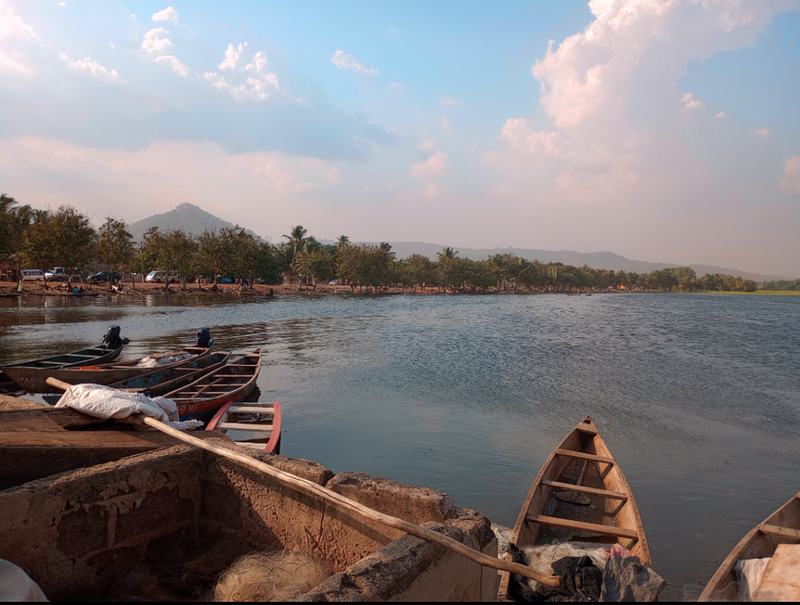
The lake is the reason Kpando exists in its present shape, and the best way to understand it is from the water. Guided trips leave from Kpando Torkor, a fishing and ferry landing point run by Emo Guide Service, for a short tour on the lake or a longer run out to inhabited islands, where you can walk ashore, swim off the cobbled edges and feel the breeze on the crossing. You can also join a local fisherman to set nets and collect the catch the next morning.
Tip: Ask for a life jacket before you board and keep it on; the Ghana Maritime Authority has been working to improve safety and life-jacket supply at Torkor, and not every boat is fully equipped.
-
2.Kpando-Torkor Fish Market and Fisheries Complex
This is a working shore, not a display. The fish market at Kpando-Torkor sits within a fisheries complex on the Lake Volta waterfront, in a community whose trade grew out of fishing and which the Member of Parliament for Kpando has described as the oldest inland landing point in the Volta Region. Come in the morning to watch canoes land and the sorting begin, and to see how a lake economy actually moves — smoked fish, ice, crates, and boats being bailed and mended.
Tip: Ask before photographing people at work, and buy something small from a trader; a market is a workplace first and a sight second.
-
Attraction
3.Kpando Pottery Fesi Shed
A women's pottery cooperative and craft centre in Fesi, founded in 1998, where pots are hand-built, burnished with stones and smoke-blackened in sawdust. You will see the whole sequence if you time it well: clay being wedged, coils and slabs becoming vessels, greenware drying in the yard, and the kiln area where finished pieces are drawn out and smothered. The shed also sells work, from cooking pots and water containers to sculptural pieces that push the same techniques into new forms.
Tip: Pieces are fragile and bulky — bring something to wrap purchases in, or ask about packing before you commit to a large pot.
-
Attraction
4.Kpando Market
The largest market in Kpando Municipal District, spread over about 1.5 hectares with a mix of permanent and temporary structures, and a trading draw that reaches well beyond the municipality into Jasikan, Hohoe, Ho and Biakoye, and even parts of the Eastern and Greater Accra Regions. It runs on a five-day cycle rather than daily, so the town's rhythm swells and settles around it. Go for foodstuffs, cloth, household goods and the particular pleasure of a market that is genuinely the commercial centre of its district.
Tip: Find out which day the cycle falls on before you plan your trip; on non-market days the same ground is far quieter.
-
5.Walk the Akpini and colonial townscape
Kpando rewards walking. A guided route through the township takes in the Akpini chiefs' palace, old German colonial buildings, the grave of an English commissioner, a Roman Catholic church and a mosque, the market, a woodcarver's workshop and a secondary school. A longer colonial walk reaches the historical site at Todzi, where the German administration's stone and brick remains stand, and continues to a viewpoint over Lake Volta. These walks are the fastest way to make sense of a town with several histories stacked on one another.
Tip: Arrange a local guide rather than wandering into the palace or mission compounds unannounced; these are working and residential places.
-
6.Day trips into the north Volta hills
Kpando works well as a base. Within reach are the Wli waterfalls in the Agumatsa Wildlife Sanctuary, the sacred Mona monkeys at Tafi Atome, Mount Afadjato and Tagbo Falls, the Likpe Todome caves, and the mountain village of Logba Tota with the Akpom Falls and a cliff wall stretching over 200 metres. Local operators organise transport, guiding and overnight stays, which matters on roads where public transport thins out after dark.
Tip: Pick one direction per day — the hills are close on a map but slow on the road, and rushing between them wastes the best hours of light.
Plan your time
Suggested itinerary
Half a day: lake and landing
Start early at Kpando-Torkor, when canoes are coming in and the fish market is at its busiest. Spend an hour on the shore, then take a short boat trip on Lake Volta — an hour on the water is enough to feel the scale of it. Finish with lunch in town and a slow walk through the market ground if it is a trading day. This is the version to choose if you are passing through on the way to or from Ho.
Kpando-Torkor Fish Market and Fisheries Complex→Kpando Torkor Lake Volta Boat Trips→Kpando Market
One day: water in the morning, clay and heights after
Begin at Torkor for the fish market and a boat trip out to an island. Return to town for lunch, then drive to the Fesi pottery shed to watch pots being burnished and fired, and buy if something catches you. Late afternoon, head up to the mountain recreation site for the canopy walk and the telescope view over the lake as the light softens. If the market cycle falls on your day, swap the pottery visit for the market and keep the pottery for the following morning.
Kpando-Torkor Fish Market and Fisheries Complex→Kpando Torkor Lake Volta Boat Trips→Kpando Pottery Fesi Shed→Kpando Lake Mountain Zipline→Kpando Market
Two days: Kpando and the north Volta hills
Day one follows the one-day plan, with the evening left free for the town — a guided Akpini walk past the palace, colonial buildings and places of worship, ending at a drinking spot. Day two heads out of town: choose the Wli waterfalls and the Tafi Atome monkey sanctuary, or Mount Afadjato and Tagbo Falls, or the Likpe Todome caves. Arrange transport and a guide the day before, and be back in Kpando before dark.
Kpando-Torkor Fish Market and Fisheries Complex→Kpando Torkor Lake Volta Boat Trips→Kpando Pottery Fesi Shed→Kpando Lake Mountain Zipline→Kpando Market
Seasons and festivals
When to go
Kpando sits in the tropical zone, pulled between the south-west monsoon winds off the South Atlantic and the dry Harmattan from the Sahara. There are two rainy seasons: the major one from mid-April to early July and a minor one from September to November. Annual rainfall averages between 900mm and 1,300mm. The mean annual temperature is about 27°C, with daily readings ranging from 22°C to 33°C; February and March are generally the hottest months and July and August relatively cooler. Humidity averages around 80 per cent. For lake trips and hill walks, the drier stretches between the rains are the most comfortable, and the Harmattan months bring hazier light over the water.
- Dayi Baakaka · Biennial; revived after a break since 1972
- Kpando's own festival, marking the ancestors' safe crossing of the flooded River Dayi on the migration from Notsé. It is celebrated with the pouring of libation at the river, and every division of the traditional area has a role in it. It was halted for decades by chieftaincy disputes and was last held in 1972; after the installation of a new Paramount Chief in March 2022, its return was set in motion. Confirm locally before planning a trip around it.
- Sasaduza, Danyigbakaka and Duawokpeza · Various, through the traditional calendar
- The municipality's traditional areas celebrate several major festivals, and many community development projects are initiated during them. Music and dance dominate, especially the Borborbor dance, and the festivals serve both as symbols of unification and as draws for visitors.
- Volta Region festival season · Largely September to December
- The wider region hosts a cluster of cultural festivals in the last months of the year, including the Asogli Yam Festival at Ho and the Agbamevorza kente festival. If your dates are flexible, this is the period when the Volta Region's public calendar is fullest.
Access
Getting there and around
Kpando is the capital of Kpando Municipal District in the northern Volta Region, about 70km from Ho, the regional capital, and roughly a four-hour journey from Accra. The town is connected by road and by ferry to Gbefi, Hohoe, Ho and Dambai, and the Ho–Kpando road has been open since 1911. The municipality's road network runs to about 242km, of which 48km are paved; conditions vary, so allow generous time for the last stretch.
From the lake side, Kpando Torkor is the municipality's water gateway. The Volta Lake forms the western boundary along a shoreline of about 20km, and engine boats link Torkor with settlements in the Kwahu North and Afram Plains districts. A ferry has long run between Torkor and Agordeke, though the main vessel has suffered breakdowns, so check the current position locally before relying on it. Within Kpando, shared taxis and tricycles cover the town, and local operators can arrange a car and driver, bicycle hire or guided transport for excursions into the surrounding hills.
Good to know
Before you go
Kpando is a small city with a working market, a working lake and a working palace, so treat all three as places where people are getting on with their day. Ask before photographing traders, fishermen, potters or anyone at the landing, and accept a no without pressing. Dress modestly away from the water, particularly around the palace, churches and mosque, and cover shoulders and knees if you plan to enter a place of worship.
On the lake, insist on a life jacket and check that the boat is not overloaded; safety provision at Torkor has been improving but is not uniform. Carry cash, since card payment is not the norm in the market or at the pottery shed, and bring a bag or wrapping for anything fragile you buy. English is widely spoken alongside Ewe, and a greeting in Ewe goes a long way. If you want to visit the palace, the mission buildings or the Todzi site, arrange it through a local guide rather than turning up unannounced.
FAQ
Questions travellers ask about Kpando
Where is Kpando in Ghana?
Kpando is the capital of Kpando Municipal District in the northern Volta Region, near the north-eastern arm of Lake Volta and the Togo border. It lies about 70km from Ho and roughly a four-hour journey from Accra.
How do I get to Kpando?
By road from Accra via Ho, or by road and ferry connections to Gbefi, Hohoe and Dambai. Kpando Torkor is the lake landing point, with engine boats linking it to settlements in Kwahu North and the Afram Plains.
What is there to do in Kpando?
Boat trips and the fish market at Kpando Torkor, the mountain zipline and canopy walk above the town, the women's pottery shed at Fesi, the five-day Kpando Market, and guided walks through the town's Ewe and colonial heritage.
When is Kpando Market held?
Kpando Market trades on a five-day cycle rather than daily, and its reach extends into Jasikan, Hohoe, Ho and Biakoye districts. Check which day the cycle falls on before you travel, as the town is much quieter between market days.
What is the best time of year to visit Kpando?
The municipality has two rainy seasons, a major one from mid-April to early July and a minor one from September to November. February and March are the hottest months, while July and August are relatively cooler.
Is it safe to go out on Lake Volta at Kpando Torkor?
Boat trips run regularly from Torkor, but safety provision varies. The Ghana Maritime Authority has deployed staff and a search and rescue boat to the area and is working to make life jackets more widely available, so ask for one and check the boat is not overloaded before boarding.
What is Kpando known for?
Its position on Lake Volta, its women's pottery tradition, a market that serves several districts, and a townscape layered with Ewe, German and British history — including the German colonial remains at Kpando Todzi.
Keep exploring
More destination guides
Sources for this guide (12)
- About – Kpando Municipal Assembly
- Kpando – Wikipedia
- Emo Guide Service @ Kpando: History
- Emo Guide Service @ Kpando: Lake Volta
- Emo Guide Service @ Kpando: Services
- Tourism | Emo Foundation
- Volta Lake Safety Boost: GMA Deploys Staff and Promises Affordable Life Jackets at Kpando Torkor – Ghana Maritime Authority
- Unlocking the promise of Kpando, Ghana – Global Citizen
- People of Kpando to celebrate Dayi Baakaka festival after 50 year's break – Graphic Online
- Volta-German Shared Colonial Heritage Project, Ghana – DAI / TANA
- Ceramics and Art in Ghana: Kpando
- The Theoretical and Socio-Cultural Dimensions of Kpando Women's Pottery – Research on Humanities and Social Sciences
Written September 29, 2026 from these sources and reviewed by the VisitGhana.app team. Confirm practical details locally before travelling.