
A grove kept by tradition
The story the village tells is one of migration and recognition. According to residents, their ancestors moved from Assini in central Ghana to the Hohoe area roughly 200 years ago, bringing with them an idol or fetish that was placed in the forest at Tafi Atome to keep it safe and cool. The forest was from that moment considered sacred and protected. Soon afterwards, villagers began to notice monkeys they believed they had seen in their original homeland, and concluded that the animals had followed them. The monkeys became 'representatives of the gods', and harming them became unthinkable.
That taboo did the work of a wildlife law for generations. The grove survived while farmland pressed in around it, and the mona monkeys (Cercopithecus mona mona) multiplied inside it. The community's own account of the grove is echoed by researchers who have studied it: the sacred grove is a habitat and species management area, and it is the traditional prohibition, not a fence, that has kept the forest intact.

When the old protection weakened
The tradition did not hold unbroken. In the 1980s, a local Christian leader brought opposing views to traditional law, and the spiritual connection between the community and the fetish forest began to fray. With the old sanctions weakened, residents cut economically viable trees, particularly around the edge of the grove, and the sacred forest was found in a state of degradation when the Accra-based Nature Conservation Research Centre visited in 1995.
What followed is the part of the story that makes Tafi Atome worth the journey. Rather than impose a fence and a fine, the village rebuilt protection around its own beliefs and gave them an economic purpose. A community-based ecotourism project began in 1996, with the support of the Nature Conservation Research Centre, Peace Corps Ghana and other partners. In 1997 mahogany trees were planted to mark the sanctuary boundary and halt the creep of farmland; in 1998 a tourist welcome centre was built as the first point of contact for arriving visitors. In 2006 the Hohoe District passed bylaws restricting entry to the forest, the damaging of trees, farming within the protected area and the killing of animals in the grove. The taboo had become law, and the law had a gate, a guide and a fee.

What the community gets back
The point of the project was never only the monkeys. Tourism income at Tafi Atome is distributed among stakeholders, including the fetish priest and the chiefs, and is used for community development, compensation for the landowners of the sanctuary, and educational funds. Surveys of villagers carried out between 2004 and 2006 found that residents felt the cultural values of the community had improved as a result of tourism promotion. The official Ghana tourism account records that revenue has brought electricity to the village, along with improvements to the school and a community clinic.
It is not a finished story. Researchers note continuing pressure from residents to clear forest for farmland and to cut trees, and pressure from tourism itself in the form of feeding the monkeys. The grove is described in the sacred-sites literature as threatened rather than secure. Visitors are part of that equation: a guided walk that respects the rules is not just a nice morning out, it is the mechanism by which the forest pays its way.

Forest, farmland and the road in
The landscape explains the place. Tafi Atome sits in the forest-savannah transitional zone, and the grove is a semi-deciduous island of tall trees standing immediately among grassland and cultivated farmland. That contrast is the whole visual drama of the village: you walk out of maize and cassava, cross a boundary of planted mahogany, and you are suddenly under a closed canopy loud with birds and butterflies. The forest is also a pharmacy and a larder for the people who live beside it. Residents know the plant species within it and use bark, leaves and roots for medicine, boiling them for drinking or bathing; mahogany bark and roots are used for hernia and as a blood tonic, mango bark and leaves for stomach ulcers and fevers. Bylaws prohibit felling trees, and the rule is to take only what you need.
At the heart of the grove is the shrine itself, where the fetish priest holds special status and conducts ceremonies associated with the forest. The shrine core is closed to all but him. That closed door is worth remembering: the sanctuary is a place of worship first and a visitor attraction second, and the two have been carefully arranged so that the first survives the second.

What to do
Things to do in Tafi Atome
-
1.Walk into the sacred grove with a village guide
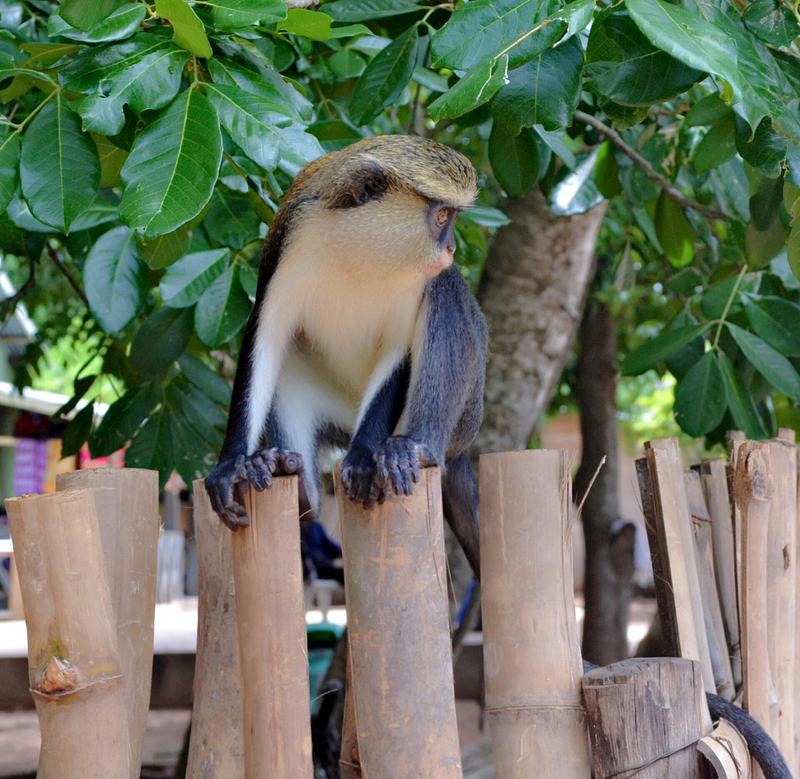
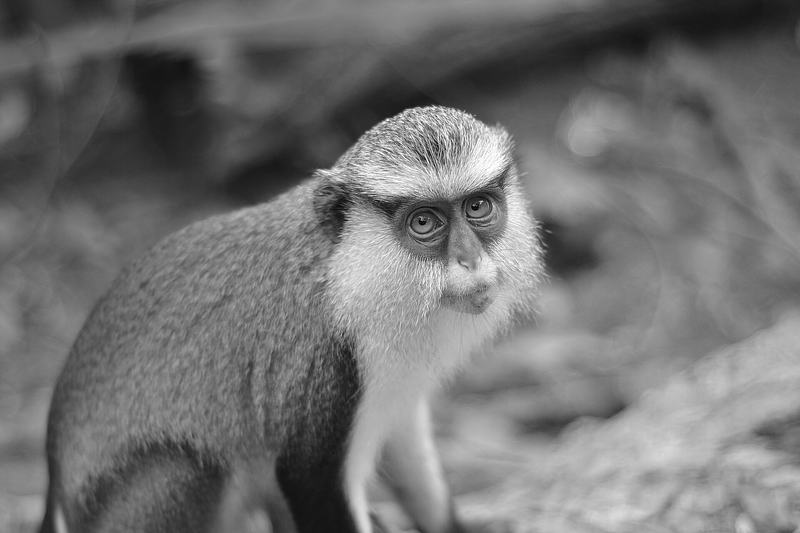
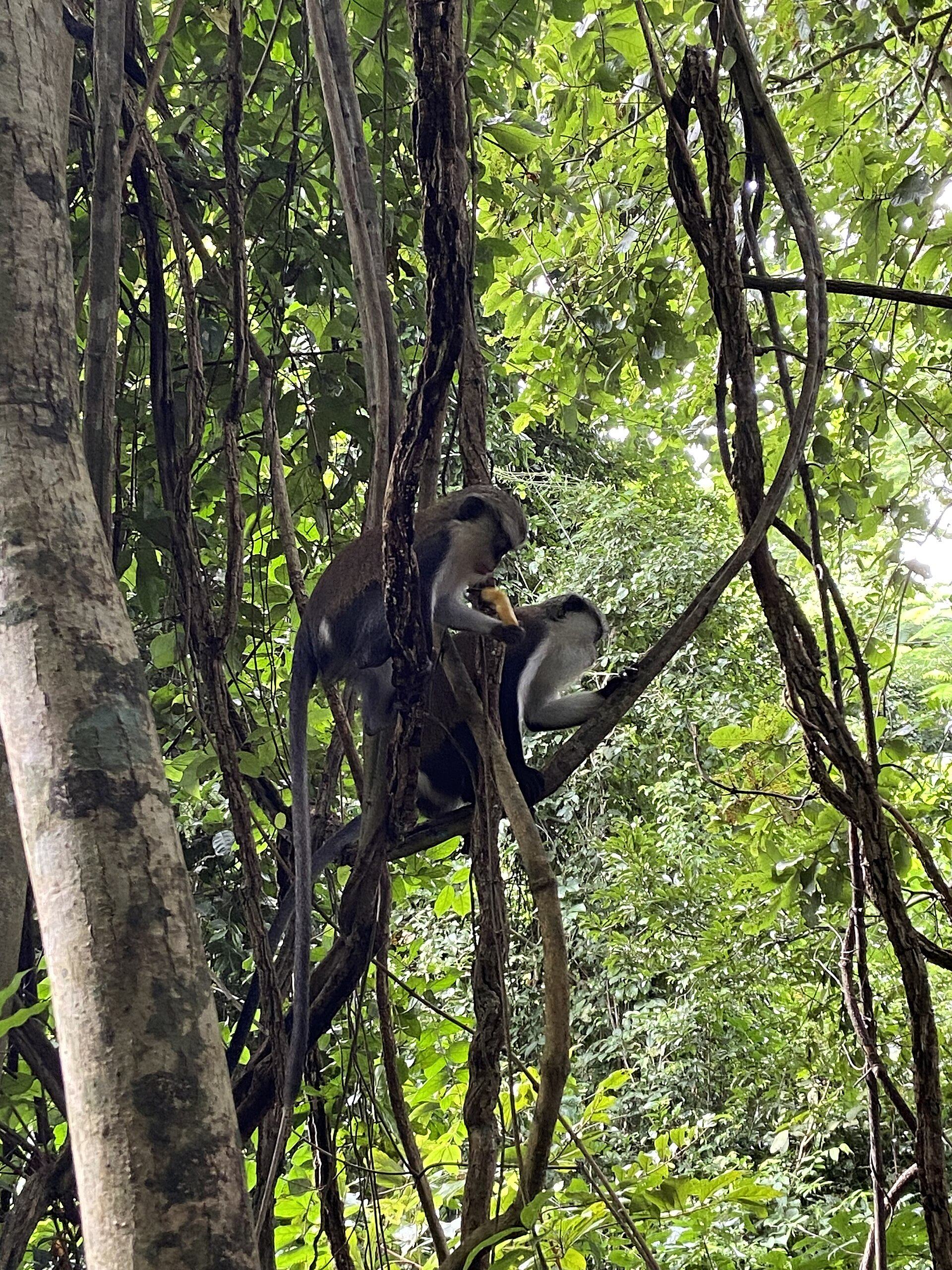
This is the reason you came. A local guide leads you from the visitor centre into the forest, where wild mona monkeys — and, less often, patas monkeys — come down from the canopy to take banana from your hand. The monkeys are habituated but not tame, and the encounter is close and unhurried. Guides explain the cultural significance of the animals and the conservation work behind the grove, which is what turns a wildlife stop into something you remember.
Tip: Go early in the morning, when the monkeys are most active and the light through the canopy is best. The walk takes roughly an hour to ninety minutes and is easy going.
-
2.Arrange your visit at the reception and information centre
The reception centre is where the sanctuary is organised: guides are assigned here, tours are booked, and the small shop sells village crafts, carvings and kente cloth. It is also the place to ask about the rustic guesthouse and homestays if you decide to stay the night. Starting here rather than wandering into the forest on your own keeps the community in control of the visit and its income.
Tip: Ask about a village tour and a pineapple-farm visit at the same time — they are arranged through the same desk and are easier to combine than to add later.
-
3.See the shrine at the heart of the grove
Inside the sacred grove stands the shrine that gives the forest its meaning — the place where the community's protective tradition is anchored and where the fetish priest conducts ceremonies. The shrine core itself is closed to everyone but the priest, so what you see is the setting and the boundary rather than the interior. Even so, walking to it with a guide makes clear that this is a place of worship, not a set, and that the monkeys are protected because of what they represent.
Tip: Ask your guide to explain the protocol before you approach, and keep a respectful distance. Photography near the shrine may be restricted — check first rather than assume.
-
4.Tour the village and meet the people who keep the grove
The sanctuary and the village are one project, and a guided village walk shows you the other half of it. You see food being prepared, daily work in the yards, and the school and clinic that tourism revenue has helped improve. It is a gentle, ordinary hour — and it is the clearest way to understand that the monkeys are not a wildlife park bolted onto a village, but a village economy built around a forest it has always protected.
Tip: A village tour takes about an hour and is easy walking. Ask before photographing people, and buy what you can from the small shops and craft stall.
-
5.Visit a pineapple farm on the village edge
A short walk out of the village brings you to a working pineapple farm, where the farmer will show you how the crop is grown and, in season, sell you fruit that has never seen a cold chain. It is a small, specific pleasure — the kind of stop that fills in the texture of a place — and it puts a little money directly into a farming household rather than a ticket office.
Tip: Takes about 45 minutes. Bring small notes for fruit, and ask your guide to arrange the visit in advance so the farmer is expecting you.
-
6.Watch kente being woven at Tafi Abuife
A few kilometres away, Tafi Abuife is one of Ghana's principal kente weaving sites, and a guide from Tafi Atome can take you there or point you along the trail. You watch weavers work the narrow strip looms, learn how patterns and colours carry meaning, and can buy cloth directly from the people who made it. It pairs naturally with the sanctuary: forest in the morning, looms in the afternoon.
Tip: It is about 14 km by road or 7 km on foot via the Cemetery Trail — a walk of well over an hour through tall grass, so take water and sun protection if you hike it.
-
7.Stay for drumming, dancing and stories after dark
If you spend the night, the village can lay on evening entertainment: drumming, dancing, or storytelling around a bonfire, offered as separate hours or a combined programme. It is informal and participatory rather than staged for a coach party, and it is the best reason to break the habit of treating Tafi Atome as a quick stop on the way to Wli. The guesthouse is rustic but comfortable, with flush toilets and showers.
Tip: Arrange the evening programme through the information centre when you book your room, and bring a torch — the village is dark at night.
-
8.Walk the forest trails and the Cemetery Trail
Beyond the monkey encounter, the grove repays a slower walk. The forest is rich in birds and butterflies, and the trails lead past the local cemetery, which sits in the forest along the Cemetery Trail. Ask your guide to show you the medicinal plants the community still uses — the bark, leaves and roots that are boiled for medicine — and the boundary mahoganies planted in 1997 to hold the farmland back. It is a chance to see a sacred grove as a working landscape.
Tip: The Cemetery Trail continues on towards Tafi Abuife if you want a longer hike. Wear closed shoes and long trousers; the path narrows and the grass grows tall.


Plan your time
Suggested itinerary
Half a day: the grove and the village
Arrive in the morning, when the monkeys are most active. Stop first at the reception and information centre to arrange a guide, then walk into the sacred grove for the monkey encounter and a look at the shrine setting at its heart. Follow it with a guided village tour to see how the community lives alongside the forest, and finish with a short walk to a pineapple farm if time allows. This is enough to understand the place, but it leaves the kente village and the evening programme for another visit.
Tafi Atome Monkey Sanctuary Tourist Information / Receptive Centre→Tafi Atome Monkey Sanctuary→Tafi Atome Monkey Shrine (Sacred Grove Shrine)→Tafi Atome Monkey Sanctuary and Cultural Village
One day: forest, farm and looms
Start early at the reception centre and take the guided grove walk while the forest is cool and the monkeys are down. Mid-morning, tour the village and visit the pineapple farm. After lunch, head to Tafi Abuife to watch kente weaving and buy cloth from the weavers, travelling by road or, for the energetic, on foot via the Cemetery Trail. Return to Tafi Atome for the evening drumming, dancing or storytelling programme before heading back to Hohoe or Ho.
Tafi Atome Monkey Sanctuary Tourist Information / Receptive Centre→Tafi Atome Monkey Sanctuary→Tafi Atome Monkey Sanctuary and Cultural Village→Tafi Atome Monkey Shrine (Sacred Grove Shrine)
Two days: stay overnight and slow down
Day one: arrive, settle into the guesthouse or a homestay, take the guided grove walk in the afternoon, then tour the village and eat a community-cooked meal before an evening of drumming and stories. Day two: rise early for the monkeys again — the light and the behaviour are different at dawn — then walk the forest trails and the Cemetery Trail, visiting the cemetery and learning the medicinal plants. Spend the afternoon at Tafi Abuife with the weavers, or use Tafi Atome as a base for Mount Afadja and Wli Falls before returning to Ho or Accra.
Tafi Atome Monkey Sanctuary Tourist Information / Receptive Centre→Tafi Atome Monkey Sanctuary→Tafi Atome Monkey Sanctuary and Cultural Village→Tafi Atome Monkey Shrine (Sacred Grove Shrine)


Seasons and festivals
When to go
Tafi Atome can be visited year-round, and the sanctuary is open daily. The one seasonal wrinkle concerns the monkeys themselves: they are generally out at any time of day, but from November through January they leave the village forest to forage, so you are most likely to see them between roughly 6:00 and 8:00 am and again between 3:30 and 6:00 pm. Outside those months, morning visits remain the most reliable and the most comfortable, before the heat builds.
The village's own calendar is worth planning around. The Dayitsotsoke community celebration falls on 2 January each year, with dancing, drumming, crafts and visiting cultural groups. The wider Volta Region has a busy festival season that pairs well with a Tafi Atome trip: the Hogbetsotso Festival at Anloga on the first Saturday of November, the Asogli Yam Festival in Ho in September, the Kente Festival (Agbamevorza) at Agotime in August or September, the Dzawuwu Festival at Dabala in February, and the Amu rice festival at Vane in Avatime in the last week of November into December.
- Dayitsotsoke · 2 January each year
- Tafi Atome's own community celebration, held on 2 January, with dancing, drumming, crafts and other cultural groups taking part. It is the one date in the year when the village itself is the main event.
- Hogbetsotso Festival · First Saturday of November
- Held at Anloga, this festival commemorates the migration of the Anlo-Ewe people from Notsie, with a grand durbar. It is the largest cultural gathering in the region and a natural pairing with a Volta itinerary.
- Asogli Yam Festival · September
- Celebrated in Ho, the regional capital, with cultural performances and durbars marking the yam harvest. Useful if you are basing yourself in Ho for a Tafi Atome trip.
- Kente Festival (Agbamevorza) · August or September
- Held at Agotime, this festival showcases kente weaving with parades and cultural displays — an obvious companion to a visit to the weaving village of Tafi Abuife.
- Dzawuwu Festival · February
- A cultural and thanksgiving festival at Dabala, celebrated with traditional dances and storytelling.
- Amu (Rice) Festival · Last week of November into December
- Celebrated at Vane in Avatime, marking the rice harvest with feasting, traditional music and cultural activities.
Access
Getting there and around
Tafi Atome lies about 43 km south of Hohoe and roughly 230 km north-east of Accra, in the Afadzato South District of the Volta Region. The village is reached from the main Ho–Hohoe road: at Logba Alekpeti, turn at the Monkey Sanctuary sign onto the dirt road and continue about 5 km to the visitor centre. Trotros run from Accra, Ho or Hohoe to Logba Alekpeti, and from that junction you take a local taxi or walk the remaining distance to the village. The village is also described as sitting off the Accra–Kpando road.
Once you are in Tafi Atome, everything is walkable: the village is small, and the forest paths and the route to the grove are easily covered on foot. Motorcycle taxis are the quickest way back to the main Ho–Hohoe road or across to the neighbouring kente village of Tafi Abuife, and they can usually be found in front of the information centre. If you are driving yourself, the sanctuary is signposted from the main road. There is no internet access in the village, so sort out any onward bookings before you arrive.
Good to know
Before you go
Tafi Atome is a living village and a place of worship, not a theme park, so let the community set the terms of your visit. Arrange a guide at the reception and information centre rather than walking into the grove alone; the fee is what keeps the forest standing, and the guide is what makes the visit make sense. Dress modestly, ask before photographing people, and treat the shrine with restraint — its core is closed to all but the fetish priest, and that boundary is not a suggestion.
Feed the monkeys only as your guide directs, and only with what the sanctuary provides; unregulated feeding is one of the pressures researchers have flagged on the grove. Bring cash in small notes, since there are no card machines nearby, and carry water, sun protection and a torch. The guesthouse is rustic — sheets are provided but towels are not — and meals are cooked by a community cook, so tell the information centre in advance if you want lunch. There is no internet in the village.


FAQ
Questions travellers ask about Tafi Atome
Where is Tafi Atome and how do I get there?
Tafi Atome is a village in the Afadzato South District of Ghana's Volta Region, about 43 km south of Hohoe and roughly 230 km north-east of Accra. From the main Ho–Hohoe road at Logba Alekpeti, turn at the Monkey Sanctuary sign and follow the dirt road about 5 km to the visitor centre; trotros run to Logba Alekpeti from Accra, Ho and Hohoe.
Why are the monkeys at Tafi Atome considered sacred?
Residents say their ancestors migrated from Assini in central Ghana around 200 years ago and noticed monkeys they believed had followed them from their homeland, so the animals came to be regarded as representatives of the gods and were never harmed. That traditional protection is the reason the grove and its monkeys survived.
What kinds of monkeys will I see?
The sanctuary is home to mona monkeys (Cercopithecus mona mona), which are the prominent residents, and patas monkeys, which are less commonly seen. The monkeys are wild but habituated to people and often come down close to visitors.
When is the best time to see the monkeys?
They are generally out at any time of day, but from November through January they leave the village forest to forage, so your best chances then are roughly 6:00–8:00 am and 3:30–6:00 pm. At other times of year, early morning is still the most reliable and comfortable window.
Can I stay overnight in Tafi Atome?
Yes. The sanctuary runs a rustic six-room guesthouse next to the visitor centre, with flush toilets, showers and sheets provided but no towels, and homestays are also available. Rooms are reserved through the information centre, and breakfast and dinner are provided for guests staying the night.
Does my visit actually benefit the community?
The project was set up that way. Tourism income is distributed among stakeholders including the fetish priest and the chiefs, and is used for community development, compensation for the sanctuary's landowners and educational funds. Revenue has also brought electricity to the village and improvements to the school and community clinic.
What else is there to do nearby?
Tafi Abuife, one of Ghana's principal kente weaving villages, is a short drive or a longer hike away, and the sanctuary can arrange a guide. Further afield, Mount Afadja (Afadjato) and Wli Falls are the classic Volta Region pairings, and Tafi Atome works well as a base for both.
In pictures
Tafi Atome in pictures
Keep exploring
More destination guides
Sources for this guide (10)
- Tafi-Atome Monkey Sanctuary – Visit Ghana
- Tafi Atome Monkey Sanctuary – Wikipedia
- Community-based Ecotourism at Tafi Atome Monkey Sanctuary, Ghana – Sacred Natural Sites
- Tafi Atome Monkey Sanctuary and Cultural Village – United Plant Savers
- Tafi Atome – Wikivoyage
- People & Places: Tafi Atome Monkey Sanctuary & Cultural Village – Graphic Online
- Tafi-Atome Monkey Sanctuary – GhanaTRVL
- Tafi Monkey Sanctuary: A sacred grove protecting rare monkey species – GhanaRemembers
- Volta Series: Tafi Atome Monkey Sanctuary – Where Nature and Humanity Coexist – ModernGhana
- Visit Volta – Tafi Monkey Sanctuary and Volta festivals
Written September 29, 2026 from these sources and reviewed by the VisitGhana.app team. Confirm practical details locally before travelling.