
A village that painted itself back into view
For centuries the women of Sirigu and the wider Kassena-Nankani community have decorated the mud walls of their compounds with geometric murals, a practice passed from mother to daughter rather than taught from any book. The work is seasonal and impermanent by design: rain strips the walls back to bare earth, and the women repaint them when the dry season returns. That cycle of renewal is part of the tradition, not a flaw in it.
By the 1990s the cycle had nearly broken. Yields were falling, young people were leaving for the cities, and the paintings — which had always needed redoing every few years — began to look like a task with no return. A retired teacher named Melanie Kasise, known locally as Mama Melanie, saw the fading designs and refused to let them go. In 1997 she founded the Sirigu Women's Organisation for Pottery and Art, beginning with 54 women. The organisation was registered that October and set out to revive the dying traditional artworks, to serve as an eco-tourism site and to raise the incomes of the women who made them.
It worked. SWOPA has since trained more than 400 women across basketry, pottery, canvas painting, mat weaving, batik and wall design, and the village became the highest tourist arrival site in the region in 2019, the same year the Ghana Tourism Authority judged SWOPA the best tourist site in the Upper East Region. In 2015 the European Commission's International Cooperation and Development Directorate-General honoured the organisation with a communications award. The walls glow again — and the women who paint them now earn from their own hands.


Reading the walls: colour, motif and meaning
The Sirigu palette is deliberately narrow: black, red and white. Traditionally the pigments come from what the land offers — white from chalk, black from basalt or soot, red from laterite — mixed with water and clay, then polished with small stones and sealed with a natural varnish. The women apply them with tools that have barely changed in centuries, including guinea-fowl feathers used as brushes and calabash scrapers for broader strokes.
The motifs carry meaning. Dots represent blessings; a zigzag triangle pattern shows respect; stripes suggest excitement; wavy lines stand for the road to success. Animals do much of the talking: the lizard symbolises friendship, the snake offers protection, a cow signals wealth, a bird stands for hope for the future, a fish for a happy home, and a basket for caring for one another. Some murals draw on folklore and belief, others on everyday life, and common motifs include triangular shards of pottery, fishing nets and sacred crocodiles.
Because the walls are inhabited and repainted, the art is never finished. A compound you photograph this season may look different in three years. That is the point: beauty here is something you tend, not something you preserve under glass.


Women's work, women's income
The revival mattered because of who it paid. In Sirigu, as across much of the district, society is patrilineal and traditionally male-dominated; women carry the bulk of household and farm work and have historically had less say in how money is spent. Painting was always women's work, but it earned them nothing.
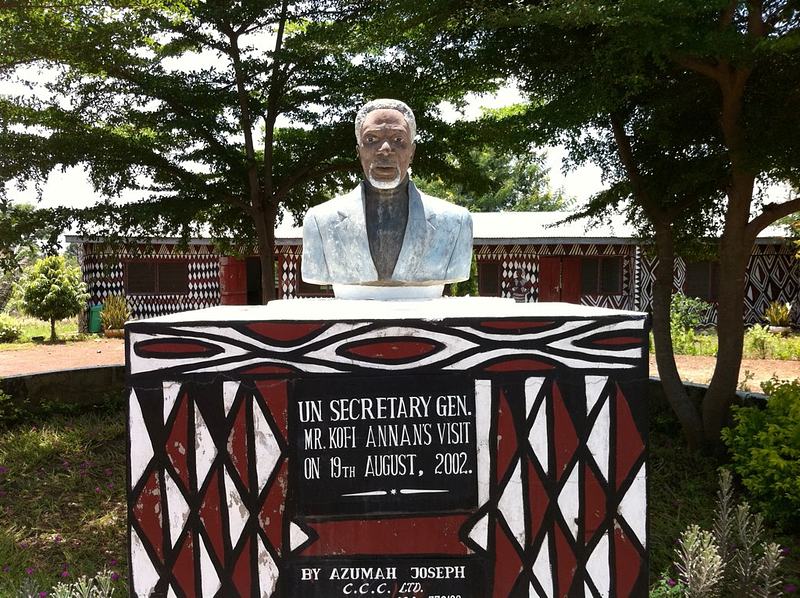
SWOPA changed the arithmetic. By selling together rather than individually, members gained bargaining power they had never had, and the organisation trained them in basic costing and record-keeping so they could price their own products. It opened sales outlets as far away as Accra and introduced canvas painting in 2002, after visitors admired the wall designs and asked to take them home. The organisation has hosted prominent guests over the years, among them the late UN Secretary-General Kofi Annan and his wife in 2004.
Today SWOPA describes itself as a women-centred NGO that also promotes food security and the welfare of rural women in Sirigu and its environs. Its work maps onto several Sustainable Development Goals, from poverty and gender equality to decent work and quality education through informal skills training. The craft is the vehicle; the point is the household income behind it.


The land, the seasons and the chief
Sirigu lies in the interior continental climatic zone, with two sharply drawn seasons. From late November to early March the harmattan blows down from the Sahara: dusty, dry, with rainfall entirely absent and daytime humidity rarely above 20 per cent. Temperatures are comparatively modest then, around 26–28°C. From May to October the tropical maritime air mass brings the rains, averaging about 950 mm a year across the district.
The landscape is Sahel savannah — open grassland swept by fire, scattered deciduous trees, and denser vegetation along the Sissili and Asibelika river basins. Dawadawa, shea, baobab, neem and mango trees are common and economically important. Agriculture employs the great majority of people here, with millet, sorghum, groundnuts, cowpea and vegetables among the main crops, and pottery, smock weaving and shea butter processing among the small-scale industries.
Sirigu is one of seven paramountcies in the Kassena-Nankana West District, and it has six Tindana — chief priests who hold the ancestral traditions in trust. The Azukodaana, Naba Roland Atogumdeya Akwara III, was enskinned as Paramount Chief of the Sirigu Traditional Area on 20 July 2015 and also serves as President of the Sirigu Traditional Council. The people of Sirigu are collectively known as Seriba, and the annual Azuko Festival, launched under his leadership, is described by the chief as the community's ancestral drum — a call to gather, remember who they are, and speak to the world about their heritage.


What to do
Things to do in Sirigu
-
Attraction
1.Walk the painted compounds of Sirigu
This is the reason most people come, and it rewards slow looking. Sirigu's inhabited family compounds are covered in geometric murals painted by Kassena-Nankani women in black, red and white, with motifs that carry meaning — dots for blessings, zigzags for respect, lizards for friendship, snakes for protection. Because these are people's homes rather than a site, the experience is a walk through a living village, not a museum circuit.
Tip: Ask at SWOPA or your guesthouse to arrange a local guide who can introduce you to families and explain the motifs; never enter a compound or photograph people without permission.
-
Attraction
2.Take a workshop at SWOPA
The Sirigu Women's Organisation for Pottery and Art is the heart of the village's craft economy, founded in 1997 by retired educationist Melanie Kasise and now training hundreds of women in basketry, pottery, canvas painting, mat weaving, batik and wall design. Visitors can join sessions led by members: learn the coiling technique for pottery, try Bolga basket weaving, or grind and mix natural pigments before painting a pattern onto a prepared mud surface.
Tip: Book workshops in advance through SWOPA so the women can prepare materials and a workspace; sessions are hands-on and unhurried, so allow more time than you think you need.
-
3.Browse the gallery and buy direct
SWOPA's visitor centre and gallery is where the work is sold, and buying here keeps the money with the makers. The organisation was set up partly to give women collective bargaining power, and members are trained in costing and record-keeping so they can price their own products. Expect pottery, baskets, mats, batik and canvas paintings — the canvas work began in 2002 after visitors admired the wall designs and wanted something they could carry home.
Tip: Buy from the gallery rather than roadside resellers where you can; ask which member made a piece, and remember that bargaining is normal but should stay respectful.
-
Attraction
4.Visit the Sirigu Traditional Arts Centre
A community-run arts centre with a gallery, workshop and guesthouse, this is a useful second anchor for craft in the village and a place to see pottery, basketry and wall painting presented together. It suits travellers who want to understand the range of local craft before committing to a workshop, and it is a practical base if you would rather stay in the village than commute from Bolgatanga.
Tip: Combine it with SWOPA on the same day — the two are complementary, and seeing both helps you tell the community's own work apart from what is made for the wider market.
-
Attraction
5.See the Azukodaana Palace
The Azukodaana Palace is the seat of the Paramount Chief of the Sirigu Traditional Area and the launch venue for the annual Azuko Festival. Sirigu is one of seven paramountcies in the Kassena-Nankana West District, and the palace is where chieftaincy, culture and tradition are handled for the traditional area. It is a working seat of local governance rather than a monument, which is precisely what makes it worth understanding.
Tip: Dress modestly and ask permission before approaching or photographing; if you want to greet the chief or his elders, arrange it through a local guide or SWOPA rather than turning up unannounced.
-
Attraction
6.Attend Mass at Martyrs of Uganda Parish Church
Sirigu's Catholic parish church is notable for walls decorated by local women with traditional mural designs, bringing the village's painting tradition indoors, and for hymn singing in Gurune. For visitors interested in how the mural tradition moves between sacred and domestic settings, it is a quietly revealing stop, and it shows the church's long presence in the community — the parish also runs the area's main health facility.
Tip: Attend as a worshipper rather than a sightseer, dress respectfully, and avoid photographing during services; check locally for Mass times rather than assuming.
-
Attraction
7.Time your visit to the Azuko Festival
The Azuko Festival is the Sirigu Traditional Area's annual cultural celebration, launched under Paramount Chief Naba Roland Atogumdeya Akwara III and held in honour of the community's founder, Azuko. The maiden edition took place in December 2025, and the second edition is scheduled for 30 December 2026. The chief describes it as the community's ancestral drum — a gathering that reminds Seriba who they are and speaks to the world about their heritage.
Tip: Festival dates and programmes are set locally and can shift, so confirm the current year's arrangements before booking travel; expect crowds and arrange transport and accommodation early.
-
Attraction
8.Pair Sirigu with the district's other heritage
Sirigu sits within a district rich in cultural and historical sites, and a visit is easily extended. The Kassena-Nankana West District's major attractions include the Paga Crocodile Pond, the Pikworo Slave Camp at Nania, and the traditional arts and cultural heritage of Sirigu itself. Building these into the same trip gives context to what you see in the village and makes the journey north feel like a coherent route rather than a single stop.
Tip: Base yourself in Bolgatanga or Paga and take Sirigu as a day trip, or stay in the village and work outwards; either way, plan your route so you are not driving the same road twice.
Plan your time
Suggested itinerary
Half a day: murals and makers
Arrive in Sirigu in the morning, when the light is soft and the heat has not yet built. Start at SWOPA, where staff can orient you and arrange a local guide, then walk the painted compounds with that guide — this is the heart of the visit and deserves unhurried time. Return to the centre for a short hands-on session, choosing pottery, basket weaving or wall painting depending on what is running. Finish in the gallery, buying directly from the women who made the work. If time allows, add the Sirigu Traditional Arts Centre before you leave.
Sirigu Craft Village / SWOPA (Sirigu Women's Organisation for Pottery and Art)→Sirigu Painted Houses (Traditional Mural Architecture)→Sirigu Women's Organisation for Pottery and Art (SWOPA)→Sirigu Traditional Arts Centre
One day: craft, chieftaincy and church
Begin at SWOPA with a longer workshop — a full pottery or wall-painting session rather than a taster — so you actually learn the technique. Break for lunch, then walk the painted compounds with a guide in the early afternoon, when shadows give the bas-reliefs depth. Afterwards, visit the Azukodaana Palace with a guide who can arrange a respectful greeting, and if you are there on a Sunday or a feast day, attend Mass at the Martyrs of Uganda Parish Church to hear the murals tradition indoors and Gurune hymns sung. Close the day at the gallery or the arts centre.
Sirigu Craft Village / SWOPA (Sirigu Women's Organisation for Pottery and Art)→Sirigu Painted Houses (Traditional Mural Architecture)→Sirigu Chief's Palace (Azukodaana Palace)→Martyrs of Uganda Parish Church, Sirigu→Sirigu Women's Organisation for Pottery and Art (SWOPA)→Sirigu Traditional Arts Centre
Two days: Sirigu and the wider district
Give the first day entirely to Sirigu: a morning workshop at SWOPA, an afternoon of compound walking and gallery browsing, and time at the Sirigu Traditional Arts Centre. Stay overnight in the village or in Bolgatanga. On the second day, widen the frame and explore the Kassena-Nankana West District's other heritage — the Paga Crocodile Pond and the Pikworo Slave Camp at Nania are the district's other major attractions, and both add historical depth to what you have seen. If your visit falls in late December, build the itinerary around the Azuko Festival instead.
Sirigu Craft Village / SWOPA (Sirigu Women's Organisation for Pottery and Art)→Sirigu Painted Houses (Traditional Mural Architecture)→Sirigu Traditional Arts Centre→Sirigu Women's Organisation for Pottery and Art (SWOPA)→Sirigu Chief's Palace (Azukodaana Palace)


Seasons and festivals
When to go
Sirigu has two sharply drawn seasons. The dry season, from late November to early March, is dominated by the harmattan: dusty, dry air from the Sahara, no rainfall at all, daytime humidity rarely above 20 per cent, and comparatively modest temperatures of around 26–28°C. This is also when the walls are at their best, because the women repaint them after the rains pass and before the next wet season. The wet season runs from May to October, bringing rains that average about 950 mm a year across the district — good for the landscape, but it strips the murals back to bare mud.
For most visitors the sweet spot is the dry season, and especially the weeks around the Azuko Festival in late December, when the village gathers for its annual cultural celebration. Note that the harmattan can be hazy and dusty, which affects photography and can be uncomfortable for anyone with respiratory sensitivity. The district also celebrates harvest festivals, including Keposiga and Mokeeka among the people of Sirigu and Kandiga, which are tied to the farming calendar rather than fixed tourist dates.
- Azuko Festival · Late December (second edition scheduled for 30 December 2026)
- The Sirigu Traditional Area's annual cultural celebration, launched under Paramount Chief Naba Roland Atogumdeya Akwara III and held in honour of the community's founder, Azuko. The maiden edition took place in December 2025. The chief describes it as the community's ancestral drum, calling Seriba together and speaking to the world about their heritage. Confirm dates locally each year.
- Keposiga and Mokeeka · Tied to the farming and harvest calendar
- Harvest-related festivals celebrated by the people of Sirigu and Kandiga, giving reverence and thanks for a good harvest. They strengthen traditional family unions and systems, and are set by the agricultural calendar rather than published tourist dates.
Access
Getting there and around
Sirigu lies in the Kassena-Nankana West District of Ghana's Upper East Region, roughly 40 km north of Bolgatanga, the regional capital. The district's administrative capital is Paga, a major border town adjoining Burkina Faso, and the Paga corridor connects Ghana with its northern neighbour, forming an important route for passenger movement and commercial activity.
Most travellers reach the Upper East by road from the south, using Bolgatanga as the gateway, and then continue north to Sirigu. The district is served by a network of local markets — Sirigu has its own, alongside Chiana, Paga, Kandiga, Mirigu, Katiu, Nakong and Kayoro — and market days are a useful way to understand how people move around the area. Within Sirigu itself, expect to walk between compounds and craft centres, and to rely on a local guide for introductions. The district's own development documents note that the poor road network within the Sirigu community has been a hindrance to moving cargo, so allow generous time for local journeys and check conditions locally before travelling, particularly in the wet season.
Good to know
Before you go
Sirigu's murals are painted on the walls of inhabited family compounds, not on a heritage site, so the first rule is consent. Ask before entering a compound or photographing people, and accept a no without pressing. Dress modestly, particularly around the palace and the church, and cover shoulders and knees as a matter of course.
Arrange workshops and guide introductions in advance through SWOPA or the arts centre, so the women can prepare materials and time. Carry cash, since craft purchases and workshop fees are paid locally and card facilities are not something to rely on. Bring water, sun protection and a hat: the harmattan is dusty and dry, and the heat builds quickly. If you have respiratory sensitivity, note that harmattan haze can be uncomfortable.
Finally, buy from the makers. The whole point of SWOPA is that women earn from their own skills, so paying the gallery directly — rather than a middleman — keeps the value where it belongs.


FAQ
Questions travellers ask about Sirigu
Where is Sirigu in Ghana?
Sirigu is in the Kassena-Nankana West District of Ghana's Upper East Region, roughly 40 km north of the regional capital Bolgatanga and close to the Burkina Faso border. The district's administrative capital is Paga.
What is Sirigu famous for?
Sirigu is known for the geometric murals painted by Kassena-Nankani women on the mud walls of inhabited family compounds, and for the Sirigu Women's Organisation for Pottery and Art (SWOPA), a women's craft cooperative founded in 1997.
What do the colours and patterns on the walls mean?
The palette is limited to black, red and white, traditionally made from natural pigments. Motifs carry meaning: dots represent blessings, zigzag triangles show respect, the lizard symbolises friendship, the snake offers protection, a cow signals wealth and a bird stands for hope for the future.
Can I take a pottery or painting workshop?
Yes. SWOPA runs hands-on sessions led by local women, including pottery using the coiling technique, Bolga basket weaving, and wall painting where you grind and mix pigments and apply them to a prepared mud surface. Book in advance so materials and a workspace can be prepared.
When is the best time to visit Sirigu?
The dry season, from late November to early March, is generally best: the harmattan brings dry, dusty conditions and the walls are freshly repainted after the rains. The wet season runs from May to October and strips the murals back to bare mud.
What is the Azuko Festival?
It is the Sirigu Traditional Area's annual cultural celebration, launched under Paramount Chief Naba Roland Atogumdeya Akwara III and held in honour of the community's founder, Azuko. The maiden edition was in December 2025, with the second scheduled for 30 December 2026.
Who founded SWOPA and why?
SWOPA was founded in 1997 by Melanie Kasise, a retired educationist known as Mama Melanie, to revive the village's dying traditional artworks, serve as an eco-tourism site and raise women's incomes. It began with 54 women and has since trained more than 400.
Keep exploring
More destination guides
Sources for this guide (10)
- Sirigu Women's Organisation for Pottery and Art — Wikipedia
- Kassena-Nankana West District — Wikipedia
- Painted earth architecture of the Kassena people — Field Study of the World
- Sirigu Paintings in Ghana Bring a Village Back to Life — Wanderarti
- The Canvas of the Ancestors: A Deep Dive into Sirigu's Painted Walls — Diaspora Affairs GH
- Women in Pottery: SWOPA Unearths the Potential and Creativity of Women in the Sirigu Community — Africa Feature Network
- Sirigu Paramount Chief celebrates anniversary, unveils second Azuko Festival — Ghana News Agency
- Upper East Region — Visit Ghana
- SWOPA — Sirigu Women's Organisation for Pottery and Art (International Service blog)
- Sirigu Women's Organisation for Pottery and Arts (SWOPA) — GhanaPortals
Written September 29, 2026 from these sources and reviewed by the VisitGhana.app team. Confirm practical details locally before travelling.