
A cathedral of earth, and the women who painted it
The story begins on 23 April 1906, when Father Morin, Father Chollet and Brother Eugène reached the English military garrison of Navarro after a long ride south from French territory. They were White Fathers — French Canadians — who had left Upper Volta fearing anti-clerical laws, and the British allowed them to settle here on condition that any school they opened taught in English. The first Mass was said in a mud hut on 1 May 1906; a small chapel followed in 1907, a larger community chapel in 1910.
The cathedral itself was completed in August 1920, its bricks moulded at a yard on the bank of the Kansula stream and carried to the site on workers' heads. It was built of mud bricks and plastered with mud mortar, a mixture of European architecture and local construction technique, and it is the last of its kind in Ghana. The building runs 60 metres long and 14 metres wide, with a 13-metre bell tower over the entrance porch flanked by two smaller towers; the floor is a compacted blend of gravel, cow dung and dawa-dawa, the yam bean. The original flat roof was replaced in 1925 with a pitched roof of trusses and corrugated iron sheets, and the tower was designed by Father Lucien Melançon and built in 1927. In 1934 the parish, by then the Mother Parish of northern Ghana, became a cathedral.
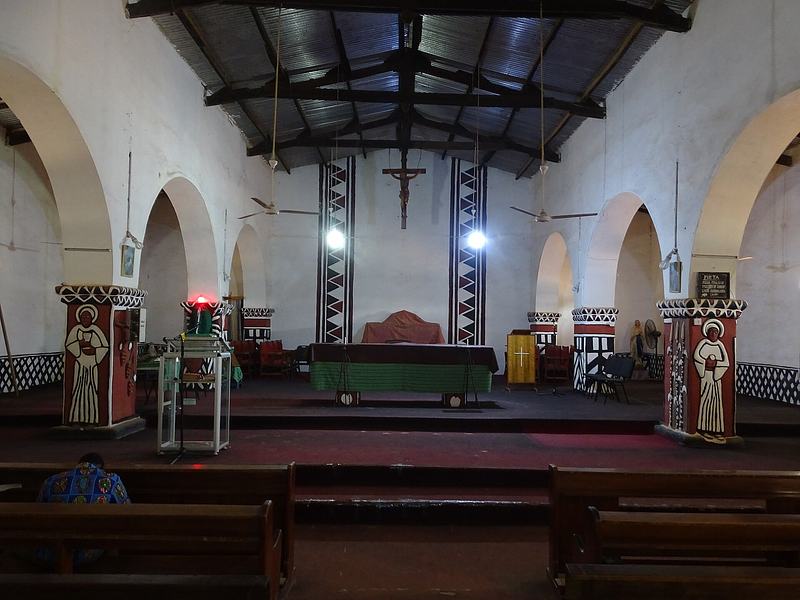
The interior as you see it now dates from 1972, when Monsignor Kizito Avereyire prepared the church for the consecration of Bishop Rudolph Akanlu. He had seen how women in Sirigu decorated their compounds and their church, and he invited seven of them to Navrongo: Akanvole Akasise, Adumpoka Akasise, Akansaare Akabange, Alobase Asika-Kugre, Asokiwine Apisigre, Atigesama Akurugu and Akurugo Akayire. Under Akanvole Akasise's artistic leadership they worked for forty days, joined by two art students from Notre Dame Secondary School who sketched the Catholic figures. The triangular pattern that dominates the church represents femininity, charm, friendship and love; the two small lambs facing each other near the side entrance stand for peace; the undulating wave is a Nankani hairstyle called dognya. A woman pounding fufu, with small particles above her representing God, retells a legend of how humanity pushed the divine further away. The decorations were refreshed later, mostly with synthetic paints on the columns, but the original colours were respected. On 17 May 2006 the church was elevated to the status of minor basilica.

A town on the caravan road
Navrongo was founded around 1740 by Butu, a Nankane-speaking hunter from Zecco in what is now southern Burkina Faso, who first settled at Pungu, a Kasem-speaking community further south. The name is an Anglicisation of navrongo: naare, foot or leg in Nankane, joined to vorongo, the sound of stepping onto muddy soil — or voro in Kasem. That is why Kasena call the town Navoro and Nankana call it Navorongo. During the nineteenth century it became an important staging post on the Sahel caravan route, and at the beginning of the twentieth century the British established a base here.
This was also slave-raiding country. Around 1840 raiders including Samori, Babatu and Bagao came through, taking people by force; captives from Burkina Faso, Mali and surrounding areas passed by Paga on their way to Salaga. In 1905 Bagao was captured, faced the firing squad and was buried under a silk cotton tree near the present District Administration offices. The British garrison that opened in Navrongo in 1904 was meant to stabilise a region still dominated by conflict and slave trading. The early twentieth century brought further blows: 1915 was the worst year of famine, when half the population of the district died and some migrated away, and the 1918 influenza epidemic killed roughly ten thousand people. The missionaries' school, which had a rocky start — the Fathers had learned the wrong local language and attracted only five students in eighteen months — was described by a British official in 1927 as the best of the five schools in the north of Ghana. After independence in 1957, Navrongo was designated district capital of the Kassena/Nankani district.

Savannah, compounds and the Fao harvest
The terrain around Navrongo is flat and the ecology typical of the Sahel: arid grassland with occasional shrubbery, lying within the Guinea Savannah woodlands. The municipality covers 865 square kilometres and shares boundaries with Burkina Faso to the north; the 2021 census put its population at 99,895. The climate is tropical savanna, hot all year, with a wet season and a dry season — Navrongo recorded 43.8°C on 26 March 2017, the highest temperature ever recorded in Ghana.
Settlement here is dispersed, with individual compounds lying sixty to a hundred metres apart. Most structures are circular in plan with flat roofs, built under the direction of a mason between November and April after the harvest, with friends and relatives helping while the owner provides food and drink. Just before the rains, the women decorate the walls. The process is exacting: soft white gora earth is sifted for the first plaster layer, reliefs are shaped by hand, then a mixture of water and cow dung is applied and evened with a flat stone; a thin layer of red laterite and cow dung goes on with a grass broom, and the motifs are painted in horizontal registers in black, dark red and white talc stone, then polished and sealed with a dawa-dawa decoction of locust bean pods and bark. Women work as a team, the most experienced leading, older generations teaching younger ones. The same repertoire — about ten painted motifs, triangles and lozenges prevailing — appears inside the cathedral.
Farming still sets the calendar. The Fao festival is an annual harvest celebration held by the chiefs and peoples of Navrongo in January, observed by communities across the Kassena-Nankana Traditional Area to thank the gods and ancestors for protection through the farming season and for a bountiful harvest. It is also an occasion to promote cultural heritage, strengthen community unity and bring natives of the area together for social and development activities. The celebration centres on a durbar of chiefs and community members, with traditional drumming, dancing and cultural performances, and participants display traditional clothing and music. A 2023 account describes men and women in smocks of every size, colour and shape, war dances by warriors carrying charms and amulets, and displays said to include cutting without injury and quenching fire with the mouth. The Tono irrigation project, built between 1975 and 1985, brought 42 kilometres of canals irrigating 2,490 hectares, and the town has been linked to the national electricity supply since 1992.

What to do
Things to do in Navrongo
-
1.Navrongo Minor Basilica
The reason most travellers come. A mud-brick Roman Catholic cathedral and minor basilica, listed by the Ghana Museums and Monuments Board as the last of its kind in Ghana, and inscribed on Ghana's tentative list for UNESCO World Heritage. Walk the two rows of columns and read the walls: hump-backed cows, crocodiles, a walking stick, a bishop's staff, the fufu-pounding woman, the lambs of peace. It is still an active place of worship, which is part of its power.
Tip: Come outside Mass times so you can look properly, and dress as you would for any church. The light on the painted columns is best in the morning.
-
2.Navrongo Basilica Museum
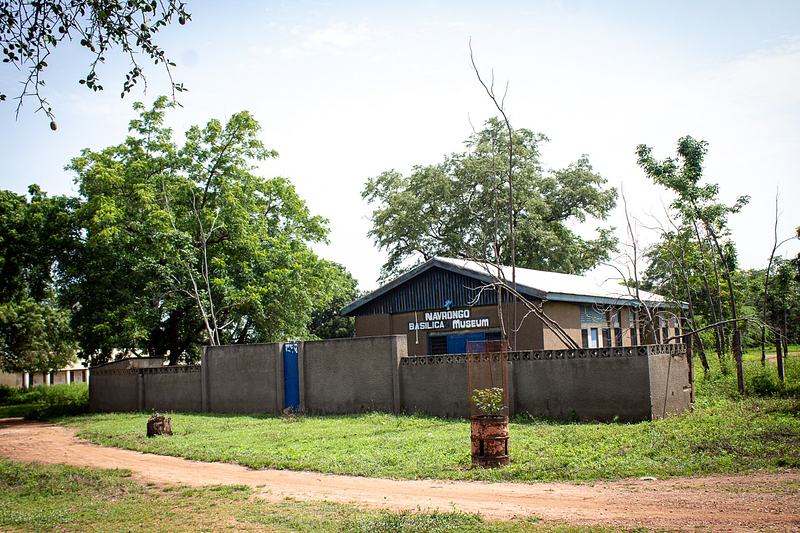
The small museum attached to the old cathedral, opened in 2004 as part of the conservation programme that also rebuilt the bell tower. Its exhibition explains the cathedral's history, the meaning of its decoration and its role as a landmark for everyone in Navrongo, and it is the best place to understand what you are looking at before or after you walk the nave. The booklet that summarises the exhibition was produced to help fund the cathedral's upkeep.
Tip: Go here first if the cathedral is busy or closed for a service — the context makes the building far more legible.
-
3.Our Lady of Lourdes Grotto
A stone shrine with an altar and a statue of the Madonna, built by Father Robert in 1933–34 at the White Fathers' mission, using stones carried from Pungu and Nayaginia. It sits within the cathedral site, which also contains accommodation facilities, and it is a quiet, shaded counterpoint to the scale of the church. Pilgrims and parishioners still use it; treat it as a place of prayer rather than a photo stop.
Tip: Pair it with the cathedral in one visit — they are on the same mission grounds, a short walk apart.
-
Attraction
4.Navrongo Central Market
The main trading hub of Navrongo and the commercial heart of the municipal capital, operating on a three-day market cycle rather than daily. This is where the raw materials of the region's decorated architecture are bought and sold — the white talc stones, the balls of dried red laterite, the dark red pebbles and the black earth that women grind into pigment. Come for smoked fish, grain, calabashes, cloth and the ordinary business of a Sahel market town.
Tip: Ask locally which day the cycle falls on before you plan around it — the market is at its fullest on its main day.
-
5.The Fao festival durbar
If your visit falls in January, build it around Fao. The annual harvest festival of the chiefs and peoples of Navrongo is observed across the Kassena-Nankana Traditional Area to thank the gods and ancestors for protection through the farming season and for a bountiful harvest. Expect a durbar of chiefs and community members, drumming, dancing, cultural performances and a great show of smocks. It is also a homecoming, drawing natives of the area back from elsewhere.
Tip: Timings can slip — a 2023 account describes a durbar due at 10am starting around 3pm. Bring water, shade and patience, and stay for the entry of the chiefs.
-
Attraction
6.Navrongo Palace (Navro-Pio's Palace)
The working traditional seat of the Navro-Pio, Paramount Chief of the Navrongo Traditional Area, and a ceremonial venue for the town. It matters most as the ritual centre of the chieftaincy you will see on display at Fao, where the sub-chiefs of the traditional area gather and the paramount chief makes his entrance. Even from outside, it helps you place the town's traditional authority alongside its Catholic history.
Tip: This is a working palace, not a museum. Ask before photographing, and be guided by whoever receives you.
-
7.Read the town's decorated compounds
The motifs inside the cathedral come from the walls of ordinary houses. In the Navrongo area, before the rainy season, groups of women render their mud dwellings with colourful low-relief adornments — incised and bas-relief designs that also break the flow of water down the walls and protect them. The decorations in Nankana villages are sophisticated and technically accomplished, and the tradition is fragile: globalisation has brought a decline, and the cathedral's interior is described as probably the sole remaining example of this art at its apogee.
Tip: Look for freshly decorated walls in the weeks before the rains, and never touch or lean on the plaster — it is soft earth, not paint.
-
8.Walk the mission grounds and old school
The cathedral is the centre of a wider mission landscape. The first White Sisters arrived in 1928, mostly Canadians who taught girls housekeeping, weaving and dressmaking, and built a school in 1932 that still stands north-west of the cathedral — the first structure here built with laterite blocks, cut and laid by Brothers Basilide and Ludovic. The two-storey bishop's residence of 1933–34 stands south-west of the church. Together they show how the mission grew from four mud huts into an institution.
Tip: These are working buildings. Keep to paths, and ask at the mission before wandering into courtyards.


Plan your time
Suggested itinerary
Half a day: the cathedral and its museum
Start at the Navrongo Basilica Museum to get the story straight — the White Fathers, the 1920 building, the seven Sirigu women who painted the interior in 1972. Then walk the basilica itself, slowly, reading the columns and the frieze on the lateral walls. Finish at the Our Lady of Lourdes Grotto on the same mission grounds, and if time allows, a short loop past the 1932 school and the bishop's residence. This is a compact, walkable half-day and the essential Navrongo.
Navrongo Basilica Museum (Old Navrongo Catholic Cathedral Museum)→Navrongo Minor Basilica→Our Lady of Lourdes Grotto, Navrongo
One day: cathedral, market and town
Morning at the basilica, museum and grotto while the light is good and the church is quiet. Midday, head to Navrongo Central Market — check first whether it is a main market day on the three-day cycle — and eat something local nearby. In the afternoon, walk the town to look at decorated compounds and the mission buildings, then pass by the Navrongo Palace to see the traditional seat of the Navro-Pio from the outside. If you are here in January, swap the afternoon for the Fao durbar.
Navrongo Minor Basilica→Navrongo Basilica Museum (Old Navrongo Catholic Cathedral Museum)→Our Lady of Lourdes Grotto, Navrongo→Navrongo Central Market→Navrongo Palace (Navro-Pio's Palace)
Two days: Navrongo and the wider Sahel
Day one as above, ending with an unhurried evening in town. Day two, use Navrongo as a base for the surrounding savannah: the flat grassland and scattered trees of the Sahel belt, the Tono irrigation area that transformed farming in the region, and the decorated villages of the Nankana countryside whose wall art the cathedral borrowed. If you are travelling on to Burkina Faso, Navrongo sits south of Paga, the main border crossing, which makes it a natural last stop in Ghana.
Navrongo Minor Basilica→Navrongo Central Market
Seasons and festivals
When to go
Navrongo has a tropical savanna climate, hot year-round, with a wet season and a dry season. Expect real heat: the mean daily maximum runs from about 30.7°C in August to 40.1°C in March, and on 26 March 2017 the town recorded 43.8°C, the highest temperature ever recorded in Ghana. Rain is concentrated between June and September, peaking in August at an average of 268.7 mm; December and January are effectively dry, with 0.0 mm and 0.2 mm respectively. The coolest months by daily mean are July and August, around 27°C, while March and April are the hottest at about 32.8°C. Plan outdoor walking for early morning and late afternoon, and build shade and water into any day.
The great reason to choose your dates carefully is Fao, the harvest festival celebrated in January by the chiefs and peoples of Navrongo and observed across the Kassena-Nankana Traditional Area. It gives thanks to the gods and ancestors for protection through the farming season and for a bountiful harvest, and it doubles as a homecoming and a showcase of music, dance and traditional dress. If you can, time your visit to it.
- Fao festival · January, annually
- An annual harvest festival celebrated by the chiefs and peoples of Navrongo in the Upper East Region, and observed by communities within the Kassena-Nankana Traditional Area. It gives thanks to the gods for protecting the people through the farming season and for a bountiful harvest, and serves to promote cultural heritage, strengthen community unity and bring natives of the area together for social and development activities. The celebration features a durbar of chiefs and community members with traditional drumming, dancing and cultural performances, and participants display traditional clothing and music. A 2023 account describes smocks of every size and colour, war dances by warriors carrying charms and amulets, and a durbar that drew a notably young crowd.
Access
Getting there and around
Navrongo is the administrative capital of the Kassena-Nankana Municipal District in the Upper East Region of northern Ghana, adjacent to the border with Burkina Faso. It sits south of Paga, the main border crossing between Ghana and Burkina Faso, which makes it a natural first or last stop on a northern route. The municipality shares boundaries with Burkina Faso to the north, Bongo District and Bolgatanga Municipal to the east, West Mamprusi Municipal to the south, and Builsa South District, Kassena Nankana West District and Builsa North District to the west.
Most travellers reach the Upper East through Bolgatanga, the regional capital, and continue to Navrongo from there; the town is also reachable from the Burkina Faso side via Paga. Once in Navrongo, the cathedral, museum, grotto and mission buildings sit together on one site and are easily walked. The market and the palace are in town. For the surrounding savannah and outlying villages you will want a vehicle or a local guide, and it is worth arranging this in advance rather than on the day. Roads in the region have improved considerably, and the town has been linked to the national electricity supply since 1992.
Good to know
Before you go
Navrongo is a working town, not a heritage park, and the cathedral is an active place of worship. Dress modestly, keep voices low inside, and do not enter during Mass. The interior decoration is earth, not paint — never touch, lean on or brush against the walls and columns, and keep bags and tripods clear of them.
Ask before photographing people, and always before photographing the palace or any shrine. The grotto is a place of prayer. If you are invited into a compound, accept the invitation as it is offered and follow your host's lead; the decorated walls you have come to see belong to somebody's home.
Heat is the other thing to plan for. Carry more water than you think you need, use a hat and high-factor sun cream, and treat the middle of the day as rest time. English is widely spoken, but a greeting in Kasem or Nankane will be warmly received. Carry cash, since card payment is not the norm in the market.
FAQ
Questions travellers ask about Navrongo
Where is Navrongo in Ghana?
Navrongo is a town and the capital of the Kassena-Nankana Municipal District in the Upper East Region of northern Ghana, adjacent to the border with Burkina Faso and just south of the Paga border crossing. It lies in the flat Sahelian grassland belt of the far north.
What is the Navrongo cathedral made of?
It is built entirely of mud bricks and plastered with mud mortar, which is why it is known as the Mud Cathedral. The Ghana Museums and Monuments Board describes it as the last of its kind in Ghana, and the floor is a compacted mixture of gravel, cow dung and dawa-dawa (yam bean).
When was the Navrongo cathedral built?
The White Fathers arrived in 1906 and completed the cathedral in August 1920, after a first chapel in 1907 and a larger community chapel in 1910. It became a cathedral in 1934 and was elevated to a minor basilica on 17 May 2006.
Who painted the inside of the Navrongo basilica?
Seven women from Sirigu, led by Akanvole Akasise, decorated the interior in 1972 for the consecration of Bishop Rudolph Akanlu, working for forty days with two local art students. They combined Nankani-Kassena motifs with Catholic symbolism, and the triangular pattern that dominates the church represents femininity, charm, friendship and love.
When is the Fao festival in Navrongo?
Fao is celebrated in January each year by the chiefs and peoples of Navrongo and communities across the Kassena-Nankana Traditional Area. It is a harvest thanksgiving for protection through the farming season and for a bountiful harvest, marked by a durbar of chiefs with drumming, dancing and cultural performances.
Is the Navrongo cathedral a UNESCO World Heritage Site?
Not yet. It is inscribed on Ghana's tentative list of sites to be nominated to the UNESCO World Heritage List, and it is a registered monument with the Ghana Museums and Monuments Board.
How hot does it get in Navrongo?
Very hot. Navrongo has a tropical savanna climate with mean daily maxima from about 30.7°C in August to 40.1°C in March, and on 26 March 2017 it recorded 43.8°C — the highest temperature ever recorded in Ghana. December and January are the driest months.
Keep exploring
More destination guides
Sources for this guide (10)
- Old Navrongo Catholic Cathedral Building — Ghana Museums and Monuments Board
- Navrongo — Wikipedia
- Cathedral Basilica of Our Lady of Seven Sorrows, Navrongo — Wikipedia
- Fao festival — Wikipedia
- Kassena Nankana Municipal — Ghana Districts
- Navrongo Catholic Cathedral — UNESCO World Heritage Tentative List
- How sons and daughters of Kassena-Nankana in Navrongo celebrated Fao Festival — Graphic Online
- FAO Festival | January — National Commission on Culture
- FAO FESTIVAL — Visit Ghana
- Navrongo Cathedral: The merge of two cultures — CRATerre-EAG / Ghana Museums and Monuments Board
Written September 29, 2026 from these sources and reviewed by the VisitGhana.app team. Confirm practical details locally before travelling.