
A trading shore on the Gulf of Guinea
Prampram sits on the Gulf of Guinea in the Greater Accra Region, and its history is written in the sea trade that passed along this coast. Long before Accra became the capital of the Gold Coast, Prampram and Ada served as significant transit points for European goods moving inland, and merchants routed bales of wax print and alcohol through the town's lands and shores. European traders set up checkpoints here to tax rival merchants and their local agents. The most visible relic of that era is Fort Vernon, a small English trading fort built in 1742 by the Royal African Company out of rough stones and swish — cheap materials that doomed it from the start. The Danes destroyed it before 1783; the British rebuilt it in 1806, abandoned it around 1816, briefly reoccupied it in 1831 and left it for good by 1844. Today it is a ruin, its walls fissured and its foundations eroded by rain and sea spray, yet it is inscribed on the UNESCO World Heritage List as part of Ghana's serial listing of forts and castles. The town also holds a quieter distinction: it is home to the first and only bulletproof police station in Ghana, built by the Danes.

The Lalue deity and the Kpledomi festival
Prampram's spiritual life centres on Lalue, the ancestral deity whose shrine anchors the town's identity. Tradition holds that the town's forebears first encountered Maa Lalue in the thick forest that once stretched from the township to the sea and the river; though the forest is gone, the rites continue. The Lalue Kpledomi festival is celebrated in three parts, each a week apart, and is preceded by a month-long ban on drumming and noise-making across Prampram and its surrounding communities, during which funerals and amplified music are prohibited. The final celebration moves to Lower Prampram, where the Kplemi drum is lowered into the sea after customary rites by the chief priest. At the Kpledo Tsoshishi — 'Beneath the Tree' — dancers go barefoot, for footwear is forbidden on ground considered sacred. The dance is not performance but veneration, and the town has begun to frame the festival as a space of remembrance and healing for visitors from the diaspora whose ancestors were shipped from these shores.

A slave-trading shore, told with care
Prampram was a hotbed of the Atlantic slave trade. European merchants used the town as an open market for the purchase and shipment of enslaved people to Europe and the Americas, and there is a belief that some captives were seized during celebrations such as the Kple. The town also saw resistance: indigenous people confronted the colonialists and fought them, though the trade found an accomplice from within — a blacksmith said to have forged the shackles used to transport the captured. He disappeared when his cover was blown and is said to have resurfaced in Jamestown, where he continued his trade until his death. Prampram was also a key ally to the Danes in their battles against the Dutch and the Fante. These histories are now being folded back into the festival's meaning, with a Remembrance Day exploring the town's relationship with slavery and the healing it offers to diasporans from America, Europe and the Caribbean. Walk this ground slowly, and let the town tell its own story.

Fishing, quarters and the shape of the town
Prampram is traditionally home to the Ga-Dangme people, and specifically to the Dangme, who occupy the coastal strip from Kpone to Ada along the Gulf of Guinea. Fishing, trading and farming have shaped Dangme life for generations, and the town is organised into quarters — Kley is one of four — each with its own elders and its own place in the ritual calendar. The shoreline remains the economic heart of the community: families depend on the Atlantic for their livelihood, and the fishermen's village is a place of work, not a staged attraction. Inland, the town is changing. Prampram is an emerging centre of industry and real estate, with new gated developments and scattered beach resorts appearing alongside the old compound houses, and the government has acquired land nearby for an aerotropolis. Weekends bring day-trippers from Accra; weekdays the beach is largely yours. The tension between growth and tradition is the live story of Prampram, and it is worth watching with open eyes.

What to do
Things to do in Prampram
-
1.Walk the ruins of Fort Vernon
Fort Vernon is Prampram's most consequential historic site: a small English trading fort raised in 1742 by the Royal African Company, destroyed by the Danes, rebuilt in 1806 and abandoned for good by 1844. What survives is a ruin of crumbling walls and eroded foundations, inscribed on the UNESCO World Heritage List as part of Ghana's forts and castles. It is a place to stand still and think about what passed through here — gold, textiles and enslaved people — rather than to photograph and move on.
Tip: The ruin is unprotected and partly used by fishermen for storage, so treat it as fragile heritage: take nothing, climb nothing, and ask locally before entering.
-
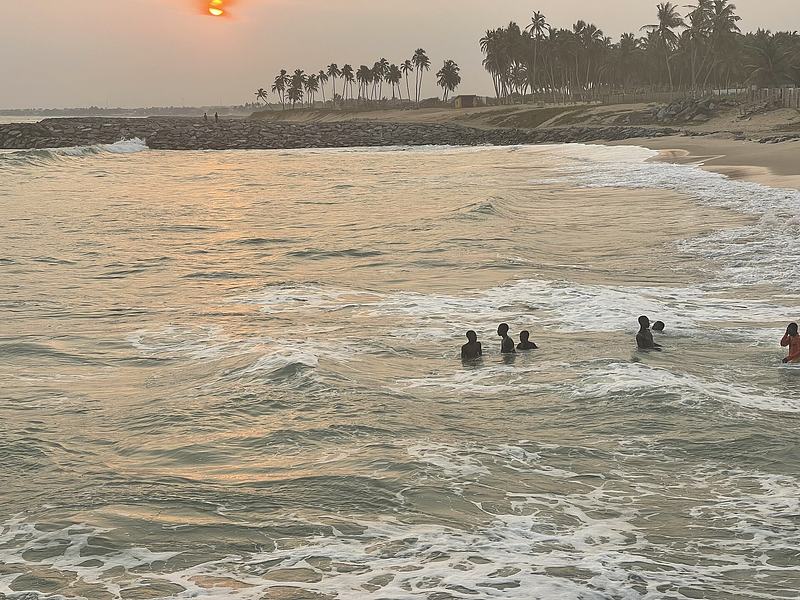
2.Spend a morning at Prampram Beach
Prampram's Atlantic-facing beachfront is the town's great open space, a long sweep of white sand that the town is known for keeping clean. It is a working beach as much as a leisure one: canoes, nets and fish crates share the sand with anyone who has come to swim or walk. Weekdays are quiet and the light is best early; weekends bring visitors from Accra and a livelier atmosphere. The Atlantic here is powerful, so this is a beach for walking, watching and paddling rather than long-distance swimming.
Tip: Come at first light to watch the canoes land, and keep well back from the surf line — the Atlantic swell along this coast is strong.
-
Attraction
3.Visit the fishermen's village
The fishing community on the shoreline is the working heart of Prampram and the clearest window onto its economy. Here you can watch artisanal marine work as it actually happens: nets repaired by hand, boats hauled up the sand, the catch sorted and sold within minutes of landing. Because this is a livelihood rather than a visitor attraction, the experience is authentic and uncommercial — and it rewards patience and courtesy far more than a camera.
Tip: Ask before photographing people at work, keep out of the way of hauling crews, and consider buying fish or a cold drink from the vendors who trade here.
-
Attraction
4.Attend the Lalue Kpledomi festival
The Lalue Kpledomi festival is Prampram's defining cultural event, a three-part veneration of the ancestral deity Lalue held on successive Tuesdays. It is preceded by a month-long ban on drumming and noise-making across the town and its surrounding communities, and it culminates at Lower Prampram, where the Kplemi drum is lowered into the sea after rites led by the chief priest. At the Kpledo Tsoshishi, dancers perform barefoot, and the town has begun to frame the festival as a space of remembrance and healing for the diaspora.
Tip: This is a sacred observance, not a show: dress modestly, go barefoot where required, follow the elders' guidance, and observe the noise ban if you are in town during it.
-
5.See the old Danish-built police station
Prampram is home to the first and only bulletproof police station in Ghana, a building constructed by the Danes and still standing in the town. It is a curious and unexpectedly telling landmark: a reminder that this quiet coastal town was once a node in European colonial administration, and that its built heritage extends well beyond the fort. It is a brief stop rather than a destination in itself, but it rounds out the picture of Prampram's layered past.
Tip: It is a working police station, so view it from outside and do not disturb officers on duty.
-
6.Eat fish where it lands
Prampram's food culture follows the catch. Grilled tilapia, fried fish and banku or kenkey appear on beachside tables and in small local kitchens, and the seafood is as fresh as it gets — often bought from the same shore you have just walked. Eating here is a way of participating in the town's economy rather than observing it, and it is one of the simplest pleasures of a visit. Ask locally for whichever spot is cooking that day.
Tip: Ask what came in that morning and order that; seafood is best when it has not travelled.
Plan your time
Suggested itinerary
Half a day: the shore and the fort
Arrive early, while the beach is still a workplace. Start at the fishermen's village and Prampram Beach as the canoes come in, then walk the shoreline and the town's lanes to the ruins of Fort Vernon, where the history of the coast's trade — including the slave trade — is at its most tangible. Finish with a late breakfast or lunch of fresh fish near the beach before heading back towards Tema or Accra. This is enough to understand what kind of place Prampram is.
Prampram Fishing Community / Fishermen's Village→Prampram Beach
One day: history, shore and town
Begin at first light at the fishing community and the beach. Mid-morning, walk to Fort Vernon and take your time with the ruins and their UNESCO context. After lunch, explore the town itself — the old Danish-built police station, the quarters and the lanes around the Lalue shrine — and ask locally about the shrine's role in the Kpledomi festival. End the day back on the sand as the light softens and the boats are pulled up for the night.
Prampram Fishing Community / Fishermen's Village→Prampram Beach→Lalue Kpledo Shrine
Two days: Prampram and the wider Dangme coast
Give the first day to Prampram: the beach and fishermen's village at dawn, Fort Vernon and the town's colonial landmarks by day, and a slow evening by the water. On the second day, use Prampram as a base for the wider Dangme coast, which runs from Kpone to Ada, and for the neighbouring district towns. If your visit coincides with the Lalue Kpledomi festival, build the day around it instead — the three celebrations fall on successive Tuesdays, and the final one moves to Lower Prampram.
Prampram Beach→Prampram Fishing Community / Fishermen's Village→Lalue Kpledo Shrine

Seasons and festivals
When to go
Prampram is a coastal town in the Greater Accra Region, and its rhythms are set as much by the traditional calendar as by the weather. The most important date to plan around is the Lalue Kpledomi festival, which is celebrated in three parts on successive Tuesdays and is preceded by a month-long ban on drumming and noise-making across Prampram and its surrounding communities. During that ban, funerals, drumming and amplified music are prohibited, and a taskforce enforces compliance — so if you are in town then, keep your own noise down. The ban is lifted at the end of the festival period. Weekdays are markedly quieter than weekends, when day-trippers arrive from Accra; if you want the beach largely to yourself, aim for a weekday. The town's own guidance is that the festival follows the Easter period, so late April into May is the season to watch for.
- Lalue Kpledomi Festival · Three celebrations on successive Tuesdays, following the Easter period (late April into May)
- Prampram's principal festival, a veneration of the ancestral deity Lalue. The first celebration honours her memory and is followed by a curfew; the second and third follow a week apart. The final celebration moves to Lower Prampram, where the Kplemi drum is lowered into the sea after customary rites performed by the chief priest. Dancers at the Kpledo Tsoshishi go barefoot, and the town has begun to use the festival as a space of remembrance and healing for the diaspora.
- Ban on drumming and noise-making · Roughly a month before the festival, ending when the festival period closes
- A traditional prohibition observed across Prampram and its surrounding communities in the run-up to Lalue Kpledomi. Funerals, drumming, music and other noise-making are prohibited, and residents are asked to observe traditional protocols. Visitors should treat it as a period of quiet and respect rather than a restriction to work around.
Access
Getting there and around
Prampram (Gbugbla) is the capital of the Ningo-Prampram District in the Greater Accra Region. It sits on the coast about fifteen minutes' drive from the port city of Tema and roughly forty-five minutes from Accra, the national capital, which makes it one of the most accessible coastal towns in the region. The district is bordered by Shai Osudoku to the north, Ada West to the east, the Gulf of Guinea to the south and Kpone Katamanso to the west, so the town is easily combined with Tema, Kpone and the wider Dangme coast towards Ada. Most visitors arrive by road from Accra or Tema, either self-driving or by shared transport, and once in Prampram the town is small enough to explore on foot — the beach, the fishermen's village, Fort Vernon and the town centre are all within walking distance of one another. For the festival's final celebration at Lower Prampram, arrange local transport or ask your host, as it takes place away from the main township.
Good to know
Before you go
Prampram is a living town, not a resort, so travel here with the manners you would use in someone's neighbourhood. Dress modestly away from the beach, and cover shoulders and knees when you approach the Lalue shrine or any sacred ground — footwear is forbidden at the Kpledo Tsoshishi, so be ready to go barefoot. Always ask before photographing people at work, especially at the fishermen's village, and accept a no gracefully. If you are in town during the ban on drumming and noise-making, keep music and conversation low; the prohibition is enforced and it matters to the community. The Atlantic along this coast is strong, with powerful swell and currents, so swim only where locals do and never alone. Fort Vernon is an unprotected ruin — do not climb on the walls or remove stones. Finally, remember that Prampram's history includes the slave trade; visit Fort Vernon and hear the festival's remembrance with the gravity they deserve.


FAQ
Questions travellers ask about Prampram
Where is Prampram in Ghana?
Prampram, also called Gbugbla, is a coastal town in the Greater Accra Region and the capital of the Ningo-Prampram District. It lies on the Gulf of Guinea about fifteen minutes' drive from Tema and roughly forty-five minutes from Accra.
What is Fort Vernon and can I visit it?
Fort Vernon is a small English trading fort built in 1742 by the Royal African Company, later destroyed, rebuilt and finally abandoned in the nineteenth century. Its ruins stand in Prampram and are inscribed on the UNESCO World Heritage List as part of Ghana's forts and castles, but the site is unprotected, so visit respectfully and do not climb on the walls.
When is the Lalue Kpledomi festival held?
It is celebrated in three parts on successive Tuesdays, following the Easter period, so late April into May is the season to watch for. It is preceded by a month-long ban on drumming and noise-making across Prampram and its surrounding communities.
Are Prampram's beaches good for swimming?
Prampram is known for long stretches of clean white sand, and the beach is lovely for walking and watching the canoes come in. The Atlantic swell and currents here are strong, though, so swim only where locals do, never alone, and stay close to the shore.
How do I get to Prampram from Accra?
Most visitors travel by road from Accra or Tema, either self-driving or by shared transport; the town is about forty-five minutes from Accra and fifteen minutes from Tema. Once there, the beach, the fishermen's village and Fort Vernon are all within walking distance of one another.
Who are the Ga-Dangme people of Prampram?
Prampram is traditionally home to the Ga-Dangme people, and specifically to the Dangme, who occupy the coastal strip of Ghana from Kpone to Ada along the Gulf of Guinea. Fishing, trading and farming have shaped Dangme life, and the town is organised into quarters, each with its own elders and ritual role.
Is Prampram worth visiting if I am based in Accra?
Yes — it is one of the closest coastal towns to the capital, and it offers a working fishing community, a UNESCO-listed fort ruin and a distinctive Ga-Dangme culture without the crowds of the city's beaches. It works well as a half-day or day trip, and better still as an overnight stay.
Keep exploring
More destination guides
Sources for this guide (11)
- Prampram — Wikipedia
- Ningo Prampram District — Wikipedia
- Fort Vernon — Wikipedia
- Fort Vernon, Prampram — Ghana Museums and Monuments Board
- Fort Vernon, Prampram: A Neglected Relic of Colonial Trade — Ghana-Net
- Gã-Dangme — Wikipedia
- A Brief History of Prampram — Prampram.com
- Lalue Kpledo Tsoshishi – a sacred space of liberation for the people of Prampram — GhanaWeb
- People of Prampram gear up for Lalue Kpledomi festival — Business & Financial Times via GhHeadlines
- Prampram to position Lalue Kpledomi Festival to entice tourists — Business & Financial Times via GhHeadlines
- Prampram ban on noise-making effective April 5-May 20 — Ghanaian Times via GhHeadlines
Written September 29, 2026 from these sources and reviewed by the VisitGhana.app team. Confirm practical details locally before travelling.