
A wall built to keep a town free
In the 19th century, long after Britain and the United States had abolished the transatlantic trade, slave raiding still bled the savannahs of what is now northern Ghana. Two warlords in particular, Babatu and Samori, are remembered in the region for their raids. Gwollu's answer was to build. The Ghana Museums and Monuments Board records that the wall was built in the 19th century by Gwollu Koro Limann as a defence against slave traders for the town's residents. Oral tradition, recorded by the colonial anthropologist R. S. Rattray in 1932 and repeated by local guides, credits a chief named Tangia, son of Yagbon, with directing the work. It was not one wall but two: a thick inner ring around the homes, pierced with triangular loopholes and four gateways, and an outer ring that enclosed the farms and the water supply. Rattray described walls of ten feet or more, with the earth dug for the bricks leaving a deep ditch, and a gap of some three hundred yards between the rings. The community built it voluntarily, in mud and grass bricks, over years rather than months. The walls were never quite finished, and were abandoned as the trade was suppressed, but the section around Gwollu survives — a rare, physical record of organised African resistance to enslavement. Walk it slowly. This is not a monument to tragedy alone; it is a monument to refusal.

A president's town
Gwollu's other claim on national memory is a birth. Hilla Limann was born here on 12 December 1934, when the town was part of the northern Gold Coast; his family name was originally Babini. He studied political science at the London School of Economics, took a diploma at the Sorbonne and a doctorate in political science and constitutional law at the University of Paris, and served as a diplomat in Lomé and Geneva. In 1979 he was elected on the People's National Party ticket and took office as Ghana's eighth president on 24 September, leading the Third Republic until he was deposed in the coup of 31 December 1981 — which makes him the only president that republic ever had. He died in Accra in January 1998 and was buried in his home town at midnight on 1 March 1998. His tomb sits within the chief's compound, and the town's senior secondary school carries his name. For Ghanaians, and for the diaspora tracing northern roots, the grave is a place of pilgrimage as much as a sight.

Crocodiles as kin, and a people of many greetings
In central Gwollu, the sacred pond known as Kalgwe holds crocodiles that the community does not regard as wildlife. Across the Sissala enclave — in Gwollu Wuljua, Bujan, Taffiasi, Nabugujan and Duu East — the reptiles are totems, understood as ancestors and souls, and it is taboo to kill, harm or eat them. As one local assemblyman put it to the Daily Graphic, every member of the clan is believed to have a crocodile that is his or her soul, and a crocodile that dies is buried as a person would be. The ponds are under pressure: drought and human activity have dried many of them, and crocodiles have strayed into bushes and homes, where some are lost to hunters and bushfires. Visiting, then, is a matter of restraint as much as curiosity. The wider culture rewards the same courtesy. The Sissala are Gur-speaking agriculturalists, known for their xylophones and for a greeting culture in which passing someone with a wave is considered rude; conversations open with family and work. The district's own festivals and dances, including the Yong-Daasi or slave-stick dance performed at Pulima, keep that history in performance.

Flat land, hard seasons, cross-border life
Sissala West covers roughly 1,814 square kilometres of northern Upper West Region, sharing its northern boundary with Burkina Faso. The land is largely flat grassland given to rain-fed farming — maize, millet, sorghum, groundnuts, cowpea, yam — with shea, dawadawa and cashew as cash crops, and cattle, sheep, goats and guinea fowl in the compounds and pastures. The single rainy season runs roughly from April to October; the rest of the year is dry, with the harmattan haze blowing down from the Sahara between December and February. Gwollu is the district capital and a market town: its weekly market, like Fielmua's, serves traders from across the border, and the district assembly counts the markets among its main sources of revenue. The town has a small water system, a hospital and rural bank agencies, but the roads are mostly feeder roads and the district's own budget names undeveloped tourism infrastructure and poor road quality among its challenges. Come expecting a working northern Ghanaian town, not a manicured site.

What to do
Things to do in Gwollu
-
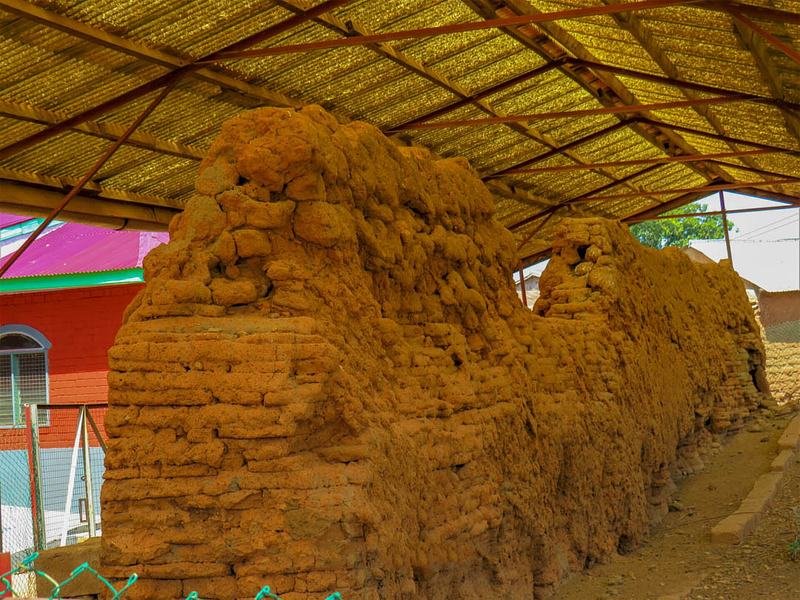
1.Gwollu Slave Defence Wall
The reason most travellers make the journey. The surviving section of the 19th-century double-ringed wall, built under Gwollu Koro Limann against slave raiders, is managed by the Ghana Museums and Monuments Board and stands beside the chief's palace, where it is kept under constant community watch. Look for the triangular loopholes cut for lookouts, and try to picture the outer ring that once enclosed farms and water sources some three hundred yards away. It is a sombre, quietly powerful place, and a rare physical testament to organised resistance.
Tip: Greet the chief and ask permission before touring; a small donation towards upkeep is customary, and photography of the wall is generally fine.
-
Attraction
2.Gwollu Kuoro's Palace (Chief's Palace)
This is a working palace, not a museum, and that is what makes it worth your time. The compound of the Gwollu Kuoro sits beside the defence wall and holds the tomb of Dr Hilla Limann, along with shrines and graves that are off limits to visitors. If you are fortunate, you may meet the chief himself and hear the town's history from someone who carries it. The palace is also the gateway to everything else here: permission to tour the wall and the tomb is sought through it.
Tip: Dress modestly, remove hats where appropriate, and ask before photographing anything inside the compound — several areas are sacred.
-
Attraction
3.Dr Hilla Limann Mausoleum / Tomb
Inside the chief's compound lies the burial place of Ghana's eighth president and the only president of the Third Republic. Limann was born in Gwollu in 1934, educated at the LSE, the Sorbonne and the University of Paris, and led the country from 1979 until the 1981 coup; he was buried here at midnight on 1 March 1998. The tomb draws school groups, politicians and diaspora visitors paying homage. Read up on the Third Republic before you come — the site rewards context.
Tip: A libation offering may be suggested but is not required; follow the family's and elders' lead on how to approach the grave.
-
Attraction
4.Gwollu Crocodile Pond (Kalgwe)
Kalgwe, the sacred pond in central Gwollu, is home to crocodiles the community reveres as clan totems rather than exhibits. Local belief holds that each clan member has a crocodile that is his or her soul, that killing one is equivalent to killing a person, and that a crocodile which dies is buried as a human would be. The animals are protected from hunting and are said to be unusually unafraid of people. It is a place to observe quietly and with respect.
Tip: Never touch, feed or provoke the crocodiles, and keep your distance — the ponds are sacred, and the animals are under real pressure from drought.
-
Attraction
5.Grave of King Tanjia (Tanjia Musa)
The Sissala West District Assembly lists the grave of King Tanjia among its tourist sites, honouring the ruler remembered for facilitating the construction of the defence wall. Oral tradition recorded by Rattray names Tangia, son of Yagbon, as the commander who built the walls around Gwollu and was later made the town's first chief. Visiting the grave alongside the wall completes the story: the structure and the person behind it. Ask locally for guidance, as the site is not signposted in the manner of a formal museum.
Tip: Combine this with the wall and palace in a single guided walk, and ask your guide to explain the different oral accounts of who built the wall.
-
Attraction
6.Gwollu Traditional Bone Setting Centre
One of the district's most distinctive living traditions, run by the Najiriwia Clan and listed by the assembly among its tourist sites. Practitioners treat fractures and other injuries using indigenous orthopaedic methods, and the centre was among the heritage sites shown to the Minister of Tourism on a recent visit to the area. This is not a performance for visitors but a working practice, so approach it as an observer with genuine interest rather than as a spectacle.
Tip: Ask permission before observing or photographing any treatment, and be guided by the practitioners on what is appropriate to watch.
-
7.Gwollu's weekly market
Gwollu's market is one of four in the district and, with Fielmua's, functions as a cross-border market serving traders from neighbouring Burkina Faso. The district assembly counts its weekly trading among the area's main revenue sources. For a visitor it is the easiest way to see the district's economy in motion — shea, dawadaka, grain, livestock, cloth — and to understand that Gwollu is a living commercial town, not only a heritage site. Go in the morning, when the market is at its fullest.
Tip: Ask before photographing traders or their stalls, and carry small notes for purchases.
-
8.Gbele Resource Reserve
Partly located within Sissala West District, the Gbele Resource Reserve is the area's main natural counterpart to its cultural sites, and its management has been involved in efforts to protect the region's crocodile ponds. It is a reasonable add-on for travellers with their own vehicle who want a half-day of savannah and birdlife after the history. Note that the reserve lies some distance from Gwollu, so plan it as a separate excursion rather than a stroll from town.
Tip: Arrange transport in advance and go early; the reserve is far from Gwollu and public transport to it is limited.
Plan your time
Suggested itinerary
Half a day: the heritage core
Start at the Gwollu Kuoro's Palace, where you greet the chief and ask permission to tour. From there, walk the surviving section of the Gwollu Slave Defence Wall beside the compound, taking time over the loopholes and the line of the vanished outer ring. Then visit the tomb of Dr Hilla Limann within the same compound, and finish at the grave of King Tanjia, the ruler associated with the wall's construction. Keep the pace slow; this is a morning for listening rather than covering ground.
Gwollu Kuoro's Palace (Chief's Palace)→Gwollu Slave Defence Wall→Dr Hilla Limann Mausoleum / Tomb→Grave of King Tanjia (Tanjia Musa)
One day: history, totems and the living town
Spend the morning on the heritage core as above — palace, wall, Limann's tomb and Tanjia's grave. After a break for food, walk to Kalgwe, the sacred crocodile pond in central Gwollu, and observe the crocodiles from a respectful distance. In the afternoon, ask locally about visiting the Gwollu Traditional Bone Setting Centre, run by the Najiriwia Clan, and time your day so you can pass through the weekly market if it is trading. End with a slow walk through town as the heat eases.
Gwollu Kuoro's Palace (Chief's Palace)→Gwollu Slave Defence Wall→Dr Hilla Limann Mausoleum / Tomb→Grave of King Tanjia (Tanjia Musa)→Gwollu Crocodile Pond (Kalgwe)→Gwollu Traditional Bone Setting Centre
Two days: Gwollu and the wider district
Give day one entirely to Gwollu: the palace, the defence wall, Limann's tomb, Tanjia's grave, the crocodile pond and the bone-setting centre, with the market fitted in around them. On day two, take your own vehicle out to the Gbele Resource Reserve, which lies partly within Sissala West District, for savannah and birdlife, and use the drive to see the flat farmland and cross-border country that shapes the district's economy. If you are travelling onward to Burkina Faso, the border is close by.
Gwollu Kuoro's Palace (Chief's Palace)→Gwollu Slave Defence Wall→Dr Hilla Limann Mausoleum / Tomb→Grave of King Tanjia (Tanjia Musa)→Gwollu Crocodile Pond (Kalgwe)→Gwollu Traditional Bone Setting Centre

Seasons and festivals
When to go
Sissala West has a single rainy season, roughly April to October, and a dry season for the rest of the year; the harmattan, a dust-laden wind from the Sahara, hazes the sky from December to February. The district assembly notes that farmers depend on this single maximum rainfall, which falls mostly between April and October. For comfortable travel, the cooler, drier months after the rains are easier than the peak heat, and the harmattan months bring dust and dry air. Be aware that the dry season is hard on the area's water bodies: the Daily Graphic reported that Gwollu's ponds dry up in the dry season, forcing crocodiles to stray, and that drought and human activity have left the region's crocodile habitats under serious pressure. If seeing the crocodiles at Kalgwe matters to you, ask locally about water levels before you travel. The district's cultural calendar includes traditional dances such as the Yong-Daasi, or slave-stick dance, performed by the people of Pulima, and the Kukur Baghr festival of the people of Fielmuo; dates vary, so confirm with the district assembly or your guide.
- Yong-Daasi (slave-stick dance), Pulima · Dates vary; confirm locally
- A traditional dance performed by the people of Pulima in Sissala West District, listed by the district assembly among the area's tourist attractions. Its name links it to the memory of the slave trade, making it a fitting counterpart to the defence wall.
- Kukur Baghr Festival, Fielmuo · Dates vary; confirm locally
- A cultural festival of the people of Fielmuo in the district, noted as attracting tourists. As with all local festivals, dates follow traditional calendars rather than a fixed national schedule.
Access
Getting there and around
Gwollu is the capital of Sissala West District, in the far north-west of Ghana's Upper West Region, close to the border with Burkina Faso. The Ghana Museums and Monuments Board places it about 70 km north of Wa, the regional capital. The district assembly lists the main highways serving the town as Hain–Kuntulo–Jeffisi to Gwollu, Hain–Zini–Gwollu, Gwollu–Fielmua, Gwollu–Silbelle and Pulima–Jeffisi, and notes that essentially all roads in the district are classified as feeder roads, with only a small proportion engineered. In practice this means slow, sometimes rough driving. One traveller's account describes the route from Navrongo via Tumu to Gwollu as roughly 150 km of driving that can take four to five hours, and considerably longer by public transport with its stops and waits. Another suggests approaching from Accra via Navrongo and Tumu, with commercial buses and the option of flying to Wa. Because public transport to Gwollu is limited, hiring a private vehicle with a driver is the most practical approach, and it also lets you reach outlying sites such as the Gbele Resource Reserve. If you are coming from Burkina Faso, the border is close. Once in town, the heritage sites — palace, wall, tomb and crocodile pond — are within walking distance of one another, and a local guide will smooth your way.
Good to know
Before you go
Gwollu is a traditional town, and the sites you have come to see are embedded in its daily and spiritual life. Begin at the chief's palace and ask permission before touring the wall, the tomb or the crocodile pond; a small donation towards the wall's upkeep is customary, and a libation may be suggested for the president's grave but is not required. Dress modestly, and use your right hand for eating, greeting and giving — the left is considered disrespectful. Ask before photographing people, shrines or the palace interior; some areas are sacred and off limits. Never harm or disturb the crocodiles at Kalgwe, which the community regards as clan totems. The region is hot, so pack light clothing, a hat, bottled water and mosquito repellent, and carry enough cash, as banking facilities in the district are limited. Roads are largely feeder roads and can be rough, so allow generous travel time and consider a private vehicle. Finally, remember that this is a working town: greet people properly, and you will be welcomed.


FAQ
Questions travellers ask about Gwollu
Where is Gwollu in Ghana?
Gwollu is the capital of Sissala West District in the Upper West Region, in the far north-west of Ghana near the border with Burkina Faso. The Ghana Museums and Monuments Board places it about 70 km north of Wa.
What is the Gwollu Slave Defence Wall and why was it built?
It is a 19th-century mud-and-brick wall built by Gwollu Koro Limann as a defence against slave traders, in a period when warlords Babatu and Samori were raiding the region. It was a double-ringed structure: an inner wall around the homes and an outer wall enclosing farms and water sources.
Was Hilla Limann from Gwollu?
Yes. Hilla Limann, Ghana's eighth president and the only president of the Third Republic, was born in Gwollu on 12 December 1934 and was buried in his home town in March 1998. His tomb is inside the chief's compound.
Can I see crocodiles in Gwollu?
Yes — Kalgwe, the sacred crocodile pond in central Gwollu, is home to crocodiles that the community reveres as clan totems and protects from hunting. They are not tame pets, and the ponds are under pressure from drought, so observe quietly and from a distance.
Do I need permission to visit the sites?
Yes. Visitors are expected to greet the chief and request permission before touring the wall, the tomb and the palace, and a small donation for the wall's upkeep is customary. Ask before photographing inside the palace, where some shrines and graves are off limits.
How do I get to Gwollu?
Most travellers drive or hire a private vehicle, typically from Wa, or approach via Navrongo and Tumu. Roads in the district are largely feeder roads and can be rough, and public transport to Gwollu is limited, so allow generous travel time.
When is the best time to visit Gwollu?
The district has a single rainy season from roughly April to October and a dry season for the rest of the year, with harmattan dust from December to February. The dry season is hard on the crocodile ponds, so if seeing the crocodiles matters, ask about water levels before travelling.
Keep exploring
More destination guides
Sources for this guide (13)
- Gwollu Defence Wall — Ghana Museums and Monuments Board
- Gwollu Defence Wall — Wikipedia
- Gwollu — Wikipedia
- Hilla Limann — Wikipedia
- Sissala West District — Wikipedia
- Sissala West District Assembly Composite Budget 2025–2028
- Gwollu Slave Defense Wall — The Hauns in Africa
- Gwollu Defence Wall — GhanaTRVL
- The Incredible Slave Trade Defense Wall of Gwollu, Ghana — Vocal
- Crocodiles stranded in Sissala — Severe drought hits water habitats — Graphic Online
- Tourism Minister visits late Dr. Hilla Limann's family to explore heritage — Adomonline
- Tourism Minister highlights Gwollu's cultural and tourism potential — Ghanaian Times
- Sissala People: The Friendly and Xylophone Playing People of Northern Ghana
Written September 29, 2026 from these sources and reviewed by the VisitGhana.app team. Confirm practical details locally before travelling.